
News
Coronavirus lockdown leaves LGBTQ Salvadorans even more vulnerable
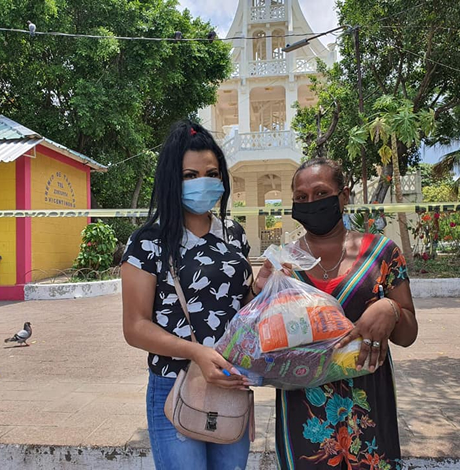
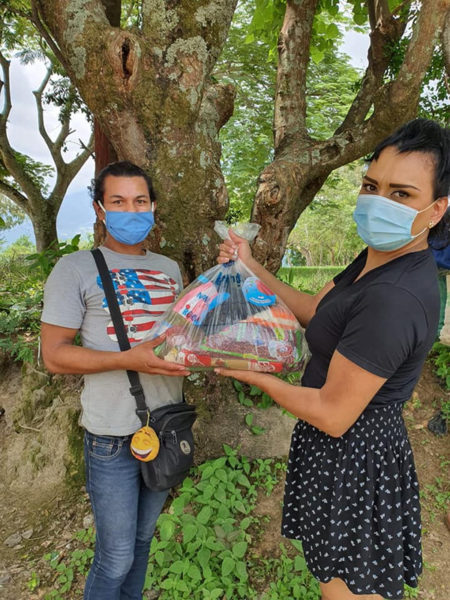
Advocacy groups, gay National Assembly candidate deliver food
Editor’s note: The Los Angeles Blade published a Spanish version of this article on June 16.
SAN SALVADOR, El Salvador — In the months since the coronavirus pandemic began in China, it has affected the whole world and El Salvador is no exception. Apart from not acquiring this virus and taking necessary sanitation measures, there are also concerns over the violation of human rights and the lack of support for the most vulnerable people who have been affected by the country’s mandatory lockdown.
One of the vulnerable groups that has been affected has been the LGBTQ community.
El Salvador since March 11 has been under a mandatory national lockdown that has, among other things, closed down the country’s businesses and face-to-face academic life. The situation has already had a significant impact on the Salvadoran economy.
“At the beginning, the situation in the country was handled correctly, such as the decision to close the airport in a timely manner; but there was poor planning,” Karla Guevara, a lawyer who is executive director of Colectivo Alejandría, told the Blade.
Guevara adds quarantine centers became “the epicenter of the pandemic” in El Salvador because they were “poorly … managed.” They have also been accused of violating the human rights of those who have been sent to them.
One such case involves a transgender man whose gender identity was not respected.
The El Salvador Transgender Men Organization (HT El Salvador) told the Blade a trans man returned from Guatemala on March 13, the day the country’s state of emergency took effect. Authorities detained him and temporarily sent him to a quarantine center in Usulután Department.
“He spent a few days in that place with other LGBTI people who had arrived in the country,” an HT El Salvador representative told the Blade. “At no time was trans people’s gender identity respected.”
The trans man was then transferred to another quarantine center in Chalatenango Department, which did not have adequate conditions. People who were housed there were not healthy and were not given food.
“HT El Salvador later brought food and personal hygiene kits to this man that could also be distributed to more trans people isolated there,” said HT El Salvador.
The organization does not know whether the kits were distributed to trans people, which led them to file complaints with El Salvador’s human rights ombudsman’s office. The conditions subsequently improved for the trans man and others isolated in the quarantine center.
“It was a clear violation of human rights for those people who allegedly violated the lockdown to be in quarantine centers,” Erick Ortiz, an openly gay National Assembly candidate for the Nuestro Tiempo party, told the Blade. “It was more complex for the LGBTI community, since there were no protocols in those quarantine centers that guaranteed an environment free of discrimination and violence; and there were unfortunately cases of discrimination and violence against gay men, lesbian women and trans people within these quarantine centers.”
While everyone was finding a way to survive the mandatory lockdown, Tropical Storm Amanda struck El Salvador in the early hours of May 31. It hit hard and affected the country’s most vulnerable areas.
Jessica Nahomy Gómez, a trans sex worker, is one of the LGBTQ people who has been affected by the heavy rains.
“My house came down because a wall next to my house collapsed; it fell on top of it,” she told the Blade.
“I have not received help either from the government nor from the municipality where I had my house. My mother, who is in very poor health, depends on me,” said Gómez, speaking about her current situation. “The only ones who have helped me with a little food have been the Trans Feminist Association of El Salvador and Aspidh Arcoíris Trans. I have felt good with that help. It is not a large amount, but I am very grateful to them.”
Help during the pandemic
The Salvadoran government’s lack of planning to meet the needs of the population under mandatory lockdown has been questioned. Civil society organizations themselves even admit they were not prepared, but it has not stopped them from trying to help.
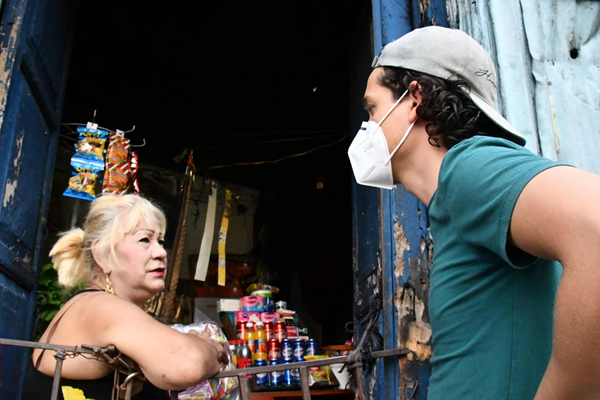
“There are LGBTI people who, in the face of all this, have gone hungry,” Roberto Zapata, general secretary of Asociación AMATE El Salvador, told the Blade. “We, as LGBTI organizations and community, have tried, to the extent that we are able, to bring support in solidarity to people we have met who are in need. We do this to be able to cover a little of what the government is not doing.”
“None of the civil society organizations are prepared for this situation,” Aspidh Arcoíris Trans Director Mónica Linares told the Blade, noting the Salvadoran government, like others around the world were also not prepared for the impact the lockdowns would have.
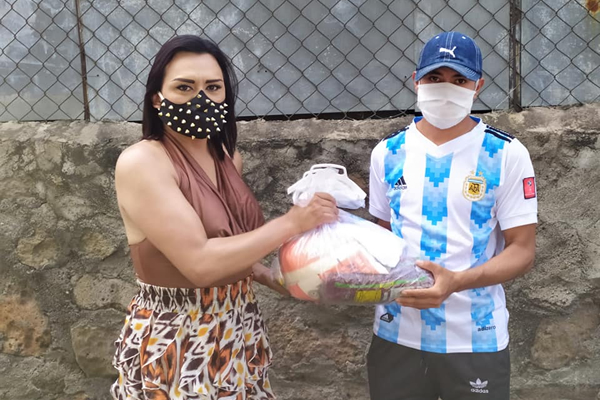
“We have tried to deliver a basket of food to LGBTI people in need with the help of donors and individuals,” she noted.
Advocacy groups try to fill aid gaps
The LGBTQ community — and especially trans people who are most likely not to be able to find a job — have suffered disproportionately during the lockdown
“Trans women who are sex workers have already not been able to work for more than 80 days, like LGBTI people who work in informal jobs,” Guevara told the Blade. “Around 40 percent of the LGTBI community has a stable job, while the other 60 percent run their own business, work in informal commerce or sex work.”
“We have been in social confinement for three months,” said Ortiz. “We are experiencing an induced economic coma. This has left part of the LGBTI community that also suffers the scourge of poverty in a very serious state of vulnerability.”
As previously mentioned, the portion of this population who engages in sex work have been hard hit by the lockdown. It will also be more affected not only because of the time out of work, but because of the precautions they will have to take to protect themselves against COVID-19 once they return to their activities in their entirety.
“I do sex work and when I can I also work in informal sales, but now that I have come to the capital of San Salvador, the place where I am staying has a sanitary code,” Gómez told the Blade. “You are always harassed by the authorities when you want to go outside.”
“I had to go to a hotel after I lost my house,” she said. “Sometimes I wash and iron the clothes of people who know me and so I earn about $5 or $3 a day.”
Before the pandemic it was already difficult to receive adequate payment for sex-related services. Gómez said no one will want to pay for sex work after the lockdown ends because the Salvadoran economy will be bad and new sanitary measures will have to be implemented.
“I have not received any help from the mayor of La Libertad, which is where I am from, nor food, material or something that I can use to fix my home,” she said.
A lack of support for LGBTQ entrepreneurs has forced them to take matters into their own hands during the pandemic. This is the case with Weirdo Sportwear, a brand of sportswear.
“As a small business, we had already planned out our first months of 2020, but we never thought of having a contingency plan for our business’ continuity,” said Eugenia Folgar, the brand’s founder.
“We took on the task of adapting to our new needs and developing a minimally viable product that would meet that need,” added Folgar.
“Today we make textile face coverings with our fabrics. We managed to reinvent ourselves,” Folgar told the Blade. “We hope that in these tough times the government will encourage support for new ventures, and for existing medium and small businesses to gain access to financing in these times of crisis.”
Branches of government at odds over COVID-19 recovery
In the midst of the crises that affect the country, the various branches of the Salvadoran government are unable to agree on measures or protocols that will help the population after the lockdown ends and economic activity resumes. The Executive and Legislative Branches continue to battle each other.
“The handling of the crisis at the Executive level has been regrettable, as it has maintained a confrontational presidential tone towards the rest of State entities,” Ortiz told the Blade.
“It is worrying because in the midst of a health crisis and an economic and social crisis that is unprecedented in the country, we also have a serious political crisis that is putting at risk the democratic advances that El Salvador has made in the years after the war,” he added.
“We as organizations are alarmed to see how the Executive has deepened its anti-human rights discourse, using its social networks and those of its officials to attack organizations that defend human rights,” says Zapata. “The government has cynically ignored, has blatantly and continuously ignored the resolutions of the constitutional chamber (of the El Salvador Supreme Court) and all apparently due to a stated electoral policy.”
Linares, on a personal note, believes the government has carried out COVID-19 prevention efforts to prevent an increase in the number of cases and deaths in the country.
“it will be regrettable that when the lockdown is lifted, the cases will increase and the LGBTI population will be affected,” she said.
“The health centers are already full,” argued Linares. “Let’s hope that this situation does not get worse and that the powers of the State can reach a consensus for the good of the general population, including us as members of the LGBTI community.”
U.N. High Commissioner for Human Rights Michelle Bachelet on April 21 expressed concern about possible human rights violations in El Salvador committed in compliance with measures imposed to stop the pandemic.
“I call on the authorities to investigate all the alleged human rights violations in the context of the implementation of the measures to fight against COVID-19,” said Bachelet in a statement.
The El Salvador Supreme Court’s constitutional chamber has taken this concern into account, as well as the many unconstitutional processes that have been presented to them as a result of the Temporary Restriction of Concrete Constitutional Rights Law to Address the COVID-19 Pandemic, contained in Legislative Decree 594, which was approved on March 14 and published in the Official Gazette the following day.
“All rights are complimentary, so therefore all laws and all decrees that come from the Legislative and Executive (branches) must be for the sake of respecting human rights, and the constitutional chamber has already said this repeatedly to the Executive and Legislative (branches),” Guevara told the Blade. “They must sit down to work out a law or a decree that respects all of the people’s rights that are enshrined in the Constitution.”
Guevara applauded the Judiciary’s work because at least it has been worried about all Salvadorans’ health and well-being. She said the problem has originated from the Legislative and Executive branches.
Government statistics as of deadline indicate there have been 3,720 confirmed coronavirus cases, with 1,843 of them recovered. The Salvadoran government also notes 74 people have died from the virus.
Due to the failure to reach an agreement between the Executive and Legislative branches, the country’s government opted to issue Executive Decree 31 that includes health protocols to guarantee people’s rights to health and life in the process to gradually reopen the economy.
The economy’s reopening was divided into five phases, which began on June 16. The reopening is expected to be completed on Aug. 31.



Palm Springs
Here’s your Palm Springs look at the weekend: Oct 23 – 25, 2026

Vote Early, Vote Often. That phrase was bandied about from the days of Chicago politics. The catchphrase ironically encourages voting multiple times under the guise of promoting voter participation. It gained widespread popularity in the early 1900s through organized crime led by Al Capone and was always invoked when I lived in the Windy City.
Today, it’s just the opposite. The Trump administration is working hard to suppress the vote ahead of the November midterms in hopes that it will help the Republicans cling to power.
I remember learning civics lessons about the importance of voting in elementary school. We held mock elections to parallel what was happening in real politics.
In high school, I participated in YMCA Youth in Government, where we went to the state capital in Lansing, Michigan, and spent most of a week sitting in chambers, drafting bills, and passing legislation that was important to us.
The trouble is, they didn’t tell us the full story of how the legislature really worked. There were no lobbyists currying favor with us, no large corporations taking us out to dinner or on exotic trips. We learned the pure version, the way our forefathers intended.
That encouraged me to run for mayor of my high school, with my girlfriend as vice-mayor. We lost, but I remained on student council. That’s probably why I’ll never run for mayor again. Scarred for life, lol!
I’m often referred to as the “unofficial mayor of Palm Springs”, an honor I’m pleased to hold. When asked about why I don’t actually run for public office, my answer is always the same: Government moves at a snail’s pace; the court of public opinion moves at internet speed. As the old saying goes, “You can’t win for losing.” The amount of vitriol that our politicians must endure is truly disgusting. Just look at your social media feed and you’ll go down a rabbit hole of half truths, false claims and piling on just for the blood sport of it.
Then there are the campaign ads. Nearly $12 billion is being spent on these ads and most is Super PAC money. This cycle we are seeing some of the worst ever. They bring deeply personal and painful experiences like sexual abuse to damage the credibility of a candidate as in Ohio’s governor’s race.
In less than two weeks, our election will take place. My upbringing taught me to take my responsibility seriously to participate in the democratic process. My hope is that the guardrails put in place by our forefathers will be enough to weather the storm of election tampering we’re seeing this cycle. I’m voting early, but not often…
Brad Fuhr, your K-Gay Desert Guide
Here’s what’s happening in sunny Palm Springs:
10th Annual East Coachella Valley Pride Festival

Gather for an inspiring afternoon of community connection, culture, and equality at the 10th Annual East Coachella Valley Pride Festival. Head to Coachella Library Park & Gardens on Saturday, October 24 from 3–8 pm for a free, family-friendly celebration and health resource fair. The event features live local entertainers, queer art displays, food vendors, and community organizations dedicated to supporting LGBTQ+ youth, families, and allies. Come honor a decade of progress and regional pride in the East Valley! More info
Reel Women’s Film Festival

See inspiring stories of trail-blazing women at Planned Parenthood’s Reel Women’s Film Festival. Gathering cinema lovers at Palm Springs Cultural Center on Sunday, October 25 from 12:30–11 pm, this 13th annual festival benefits Planned Parenthood of the Pacific Southwest. Featured films include The Inquisitor, highlighting congresswoman Barbara Jordan and her longtime partner Nancy Earl, alongside inspiring documentaries telling the powerful journeys of Somali runner Samia Yusuf Omar and Israeli activist Efrat Tilma. More info
62nd Annual Golf Cart Parade

Colorful floats, marching bands, and whimsical decorations roll down El Paseo during the 62nd Annual Golf Cart Parade. Head over to El Paseo Shopping District on Sunday, October 25 to experience this beloved community tradition. Festivities start early at 8 am with a marketplace, food vendors, dance groups, and a dedicated kids zone, followed by the main parade processional at 12 pm. Keep an eye out for KGAY’s Brad Fuhr and John Taylor, taking part in the parade aboard the all-electric OPTIQ from Jessup Cadillac! More info
Best of CV – Final Round Voting Final Day is Friday

CV Independent’s Best of Coachella Valley 2026–2027 final voting round is wrapping up and this is your chance to help crown the winners across the valley’s most‑loved radio stations, personalities, DJs (and many more categories). Thank you for showing us the love already with a strong nomination phase! Our finalists include KGAY 103.1 and Sunny 106.5 for Best Radio Station; John Taylor, E.J. Tyler and Patrick Evans for Best Local Radio Personality; and the dynamic DJ trio — DJ Galaxy, DJ Eric Ornelas, and MODGIRL — for Best Local DJ. Voting continues through Friday, October 23, so cast your vote and help celebrate your favorites in this year’s Best of Coachella Valley! Vote Today
Naked Yoga

Marvel at fine art photography during Naked Yoga, a stunning exhibition featuring thirty rare silver gelatin prints by renowned photographer Michael Childers. This free three-day event runs Friday–Sunday, October 23–25 at Stephen Baumbach Gallery. Opening night on Friday, October 23 from 5–7 pm offers wine and a live Yogi flow demonstration. On Saturday, October 24 from 3–5 pm, enjoy tea, cookies, and conversation with the artists. The showcase concludes Sunday, October 25 from 5–7 pm with a final meditation session. Sales of signed framed prints directly benefit yoga teacher certification scholarships. More info
Perez Art District: 4th Friday Art Walk & “Conversations with the Land” Show

Immerse yourself in Cathedral City’s creative scene during the 4th Friday Art Walk featuring the special “Conversations with the Land” show. Stroll through open working studios at Perez Art District on Friday, October 23 from 4–7 pm to meet talented local artists, watch live demonstrations, and purchase original art directly from creators. This multi-media exhibition features desert-inspired works by twenty local artists exploring nature, highlighted by a special 5 pm performance by the Bird Singers from the Agua Caliente Band of Cahuilla Indians and poetry recitations by Cathedral City Poet Laureate Clare Chu.
REAF House Party PS

Celebrate in grand style at the REAF House Party PS – Pride in Paradise 2. Set for Saturday, October 24 from 5–8 pm at a private address in Andreas Hills, this tropical cocktail party features spectacular live entertainment. Billboard recording artist Debby Holiday performs alongside drag superstar Billy L’Amore, jazz diva Keisha D, the SOS Entertainers dance troupe, and the Desert Studs gogo dancers. KGAY Morning Show host John Taylor is hosting, and KGAY’s own spin master DJ Galaxy provides high-energy music throughout the evening. Don festive tropical or Pride attire to enjoy an unforgettable evening of music, dancing and community celebration surrounded by stunning desert views. More info
This Weekend at the McCallum Theatre

Sensational live stage entertainment fills the lineup this weekend at McCallum Theatre. On Saturday, October 24, the dazzling circus spectacular C!RCA: Duck Pond reimagines Swan Lake with breathtaking acrobatics, humor, and an energetic duck army. Closing out the week on Sunday, October 25 at 2 pm, Broadway favorite Megan Hilty delivers a powerful vocal concert featuring beloved musical hits. More info
This Weekend at The Purple Room

On Friday and Saturday, musical comedy duo Lauren Molina and Nick Cearley strip down to their underwear as The Skivvies for The Rocky Horror Skivvies Show, delivering mash-up arrangements of Richard O’Brien’s cult musical classics. Then on Sunday, celebrated entertainer Michael Holmes takes the stage in The Judy Show! to deliver a hilarious, razor-sharp parody of Judy Garland hosting Hollywood legend guest stars. More info
Dracula: A Comedy of Terrors

Get ready for a hilarious, bloodthirsty night of entertainment as Revolution Stage Company kicks off its fourth season with Dracula: A Comedy of Terrors. Running October 15–31, this fast-paced, 90-minute gender-bending stage farce combines gothic horror with Python-esque humor. The story follows a meek British realtor who takes on a terrifying vampire client whose deep pockets are irresistible and whose attraction to his fiancée is concerning. Our theatre reviewer Stephen Radosh calls the production “A wildly entertaining theatrical experience… a fast-paced, laugh-out-loud comedy.” Read his full review and Get tickets
Cat on a Hot Tin Roof

Cat on a Hot Tin Roof runs October 9–24, presented by THE BENT. Tennessee Williams’ Pulitzer Prize‑winning masterpiece holds deep significance for LGBTQ+ audiences, exploring repressed homosexuality, internalized homophobia, and the destructive nature of the closet. This production highlights the hidden desire between Brick and Skipper, offering a fresh interpretation of Williams’ groundbreaking work. More info
Bound 4K Screening w/ Local Queer Erotic Short ‘Bite the Boot’

Experience a special one-night-only film event as Festival Theaters Palm Springs host a special screening of Bound on Friday, October 23 from 7–9:30 pm. Three years before The Matrix, directors the Wachowskis unleashed their iconic sapphic heist thriller starring Jennifer Tilly and Gina Gershon. This stunning 4K re-release is paired with the high desert queer erotic short film “Bite the Boot” by XilaMonstrr Productions. Attendees can also participate in an exclusive Q&A session with the creators of the short film immediately following the showing. More info
Into the Woods

Fairy tales collide in magical ways as Stephen Sondheim’s award-winning musical masterpiece Into the Woods comes to life outdoors. Running Friday–Sunday, October 23–25 at Rancho Mirage Amphitheatre, this whimsical production features music and lyrics by Stephen Sondheim and a book by James Lapine. The talented cast stars Lizzie Sosa, Jacob Lozano, and Catrina Teruel following a baker and his wife on a quest to reverse a curse. Experience an unforgettable theatrical journey about courage, consequence, and community. More info
Burgers, Boys & Brews Sunday BBQ

Every Sunday from 2:30–4:30 pm, The Social Cafe & Lounge hosts Burgers, Boys & Brews, a backyard‑style cookout featuring fresh‑grilled burgers, hot dogs, sides, bottomless mimosas, bottomless draft beer, and live male entertainment. Come for great music, cold drinks, and a lively crowd ready for a fun, all‑inclusive brunch experience. More info
- Joy’n Us • VR filmmaker Travis Hutchison showcases newly discovered 1970s archives from photographer Frank Diernhammer at Materias Primas, opening Friday. The multimedia exhibition includes vintage prints, 8mm film, and virtual reality honoring Antonio Lopez and Juan Ramos, with proceeds benefiting DAP Health.
- Floating Sound Bath Experience • Guests float in an outdoor saltwater pool for a restorative guided meditation session launching Friday at 6:30 pm at JW Marriott Spa and Resort. The 60-minute experience combines soothing sound frequencies and serene mountain views.
- Life Without Limits Sock Hop Luncheon • United Cerebral Palsy of the Inland Empire hosts a retro 1950s-themed fundraising luncheon on Friday from 11:30 am–1:30 pm at Agua Caliente Casino Resort Spa Rancho Mirage.
- Perez Art District: 4th Friday and 2nd Saturday Art Walk • Local art lovers gather to explore working studios and meet creative talent on Friday from 4–7 pm at Perez Art District. Conversations with the Land • Twenty local artists showcase desert-inspired artworks during a multi-media exhibition during the Art Walk. The event features a special 5 pm performance by the Bird Singers alongside poetry recitations by Clare Chu.
- 38 Special – Milestone • Southern rock band 38 Special performs classic platinum hits and fresh tracks on Friday at 8 pm at The Show at Agua Caliente Casino Resort Spa.
- La Quinta CV Link Day • The City of La Quinta invites residents and visitors for a morning walk or ride on Saturday from 8–10 am at Jefferson Street & Vista Grande. Participants can explore the 40-mile CV Link pathway with free e-bike rentals, water, and snacks.
- Miralon Community Blood Drive • LifeStream and the Miralon community host a lifesaving blood drive on Saturday from 9 am–2 pm at MiraBar. Donors can walk in or schedule appointments to help save lives while receiving a limited-edition Halloween-themed T-shirt while supplies last.
- An Evening at COPA: Where Rhythm Meets Philanthropy • Hanson House Foundation presents a Copacabana-inspired gala dinner on Saturday from 5–10 pm at Palm Springs Air Museum. The evening honors community leaders Dick Shalhoub, Gerald “Jerry” Keller, Linda Evans, Oliver Jack, and Sherman Tam, with special recognition for Dr. Ercoli.
- Atomic Pink Bash • Metropolitan Fashion Week hosts a high-fashion fundraiser supporting earthquake relief on Saturday from 6–10:30 pm at The Velvet Rope. Highlights include a presentation styling breast cancer survivors, runway shows, fine art, vocalists, and a dessert table, with tunes from KGAY’s DJ Galaxy!
- Unbuttoned: A Boylesque Social Experience • Performer Michael Silas, former dancer for Lady Gaga, delivers an intimate boylesque show on Saturday from 7–8:30 pm at The Social Cafe & Lounge.
- Dance Ranch – Country Dance Saturdays • Country western dancers of all skill levels gather for an inclusive dance social on Saturday from 7–9:30 pm at Step by Step Dance Studio. Instructor Rob Ollander-Krane leads a beginner shadow lesson at 7 pm followed by open social dancing.
- Charged Stillness Exhibition • Local artist Tina Roy showcases vivid paintings reflecting the beauty, drama, and delicate ecosystems of the wild desert from through October 29 at Rubine Red Gallery.
White House
Allegations involving Ric Grenell raise questions about pay-for-play in White House
Gay administration official at center of questions involving paid access to Trump

Questions about how high-level political appointees wield their power have long persisted, particularly under the Trump-Vance administration. Now, allegations involving openly gay Special Presidential Envoy for Special Missions Ric Grenell, White House adviser Alina Habba, and her husband, Turkish businessman Turhan Mildon, are making headlines across newsrooms.
The allegations have prompted President Donald Trump to order an investigation into what has become a convoluted mess, raising questions about a potential “pay-for-play” scheme within the White House.
Axios first reported that Habba accused Grenell of directing her husband to send $17.6 million to a Texas defense and security company, with approximately $5.6 million supposedly earmarked for the Kennedy Center. A text message allegedly sent by Grenell to Mildon promised VIP events and access to administration officials, including Trump, in connection with arranging a donation.
“Once the money comes to the company here, I will arrange the donation to Kennedy center, and you’ll be joining the VIP events and get close with the administration, even with POTUS,” the message allegedly sent by Grenell reads, according to Axios.
Habba, a former U.S. attorney for New Jersey, has alleged that the Kennedy Center never received the donation. Grenell, who served as the center’s acting director from February 2025 to March 2026, has denied sending the text message and called the allegations against him false.
According to Axios, Habba raised concerns with Trump on Oct. 9 after money had reportedly been sent to the Texas company but the promised donation to the Kennedy Center had not materialized. One administration official described Habba as “pretty animated” during the discussion and said she exclaimed at one point, “Ric stole the money!”
However, an administration source told Axios that Habba had not gathered all the necessary information before making the accusation.
“[She] didn’t have all her stuff in order. She went in there half-cocked without all the facts yelling about Grenell stealing. And the facts keep changing,” the source told Axiso. “That doesn’t mean Ric is out of the woods. This looks really shady.”
Following Habba’s accusations, Trump called White House Counsel Will Scharf into the Oval Office and asked him to investigate her claims, according to sources cited by Axios.
Trump and Scharf then called Grenell, who denied the allegations and said he would have immediately alerted others if he had known about a $17 million contribution.
“There’s no way this is true. This is crazy,” Grenell told Trump at one point, according to a source briefed on the discussion.
The Kennedy Center reportedly has no record of receiving the alleged $5.6 million contribution. The White House investigation remains ongoing, with officials examining the digital authenticity of the disputed text message.
Grenell has denied soliciting money under false pretenses or receiving any payment from Mildon.
“I’ve never asked for one cent to be sent somewhere else pretending it was for the Kennedy Center, and I’ve never received any payment from him at all,” Grenell said. “Make him give proof to what he is saying, not make these absurd allegations.”
The amount Habba cited has also reportedly changed. She initially claimed the donation intended for the Kennedy Center totaled approximately $17 million, while the amount allegedly designated for the performing arts institution appears to have been $5.6 million.
The allegations come amid broader questions about corruption within the Trump-Vance administration. Vice President JD Vance addressed the issue last week when asked whether he had witnessed anything inside the White House that gave him pause.
“D.C. is a corrupt town,” Vance said. However, he added, “I have not seen a single shred of evidence that [Trump] participates or sanctions in that corruption.”
The Los Angeles Blade reached out to the White House, Habba, and Grenell for comment but did not receive a response before publication.
New Zealand
New Zealand High Court strikes down puberty blocker ban
Transgender advocacy group challenged government’s 2025 regulations

New Zealand’s High Court on Wednesday struck down regulations that banned new puberty blocker prescriptions for minors.
The Professional Association for Transgender Health Aotearoa Inc. challenged the Health Ministry over the regulations it adopted in 2025.
“The applicant successfully bought a claim for a breach of an obligation to consult under s 105 of the Medicines Act 1981 (Medicines Act),” says a press release that announced Justice Dale La Hood’s ruling. “The applicant was also successful in their claim that the minister unlawfully discriminated against young people with gender incongruence or gender dysphoria on the round of disability contrary to s 19 of the New Zealand Bill of Rights Act 1990 (Bill of Rights). The applicant’s claims that the minister abdicated his decision-making power to Cabinet and acted for an improper purpose were unsuccessful.”
“The court declined to separately determine the applicant’s claims that the minister made material mistakes of fact or that he reached an irrational decision,” added the press release. “The court also declined to determine whether there was discrimination on the basis of sex or whether the decision breached ss 8, 9 and 10 of the Bill of Rights.”
The Professional Association for Transgender Health Aotearoa welcomed the ruling.
“As clinicians, we see clearly the benefits of puberty blockers and the significant impact they have on the lives of young transgender people,” said Elizabeth McElrea, a doctor who is the advocacy group’s vice president, in a press release. “Decisions about this healthcare are best made by patients and their doctors. The removal of this regulation is crucial and puts that decision back in the consult room.”
“This judgment means that as clinicians we can continue to prescribe GnRH agonists in line with best practice and without fear of retribution for doing the right thing,” added McElrea.
U.S. Supreme Court
Supreme Court blocks White House anti-trans prison policy
Justices side with trans inmates who challenged Trump-Vance administration directive
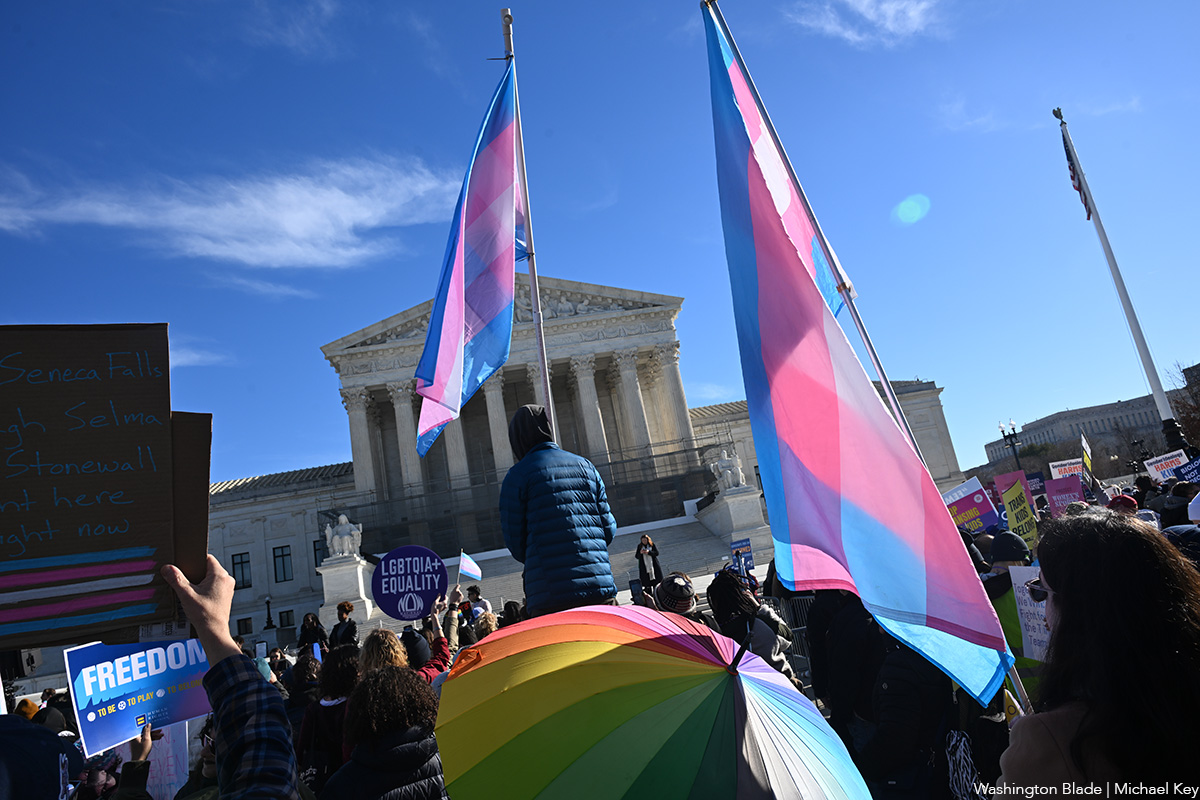
The U.S. Supreme Court has blocked a Trump-Vance administration policy that would have ended gender-affirming care for prisoners.
On Wednesday, the justices rejected an emergency application filed by the administration that would have allowed the Bureau of Prisons to restrict gender-affirming care for transgender inmates in federal prisons.
Three prisoners, Alishea Kingdom, Jas Kapule and Solo Nichols, have said they had been receiving hormone therapy for years as inmates and challenged the sudden policy change. They argued that the abrupt change to decades of policy would end treatment for nearly 1,000 people in custody. The assertion of security concerns within prisons, the American Civil Liberties Union told the Supreme Court, was odd “given that BOP has not pointed to a single security incident relating to its provision of this treatment over the past 30 years.”
According to the application, President Donald Trump’s order called on the Bureau of Prisons to revise its medical care policies so that federal funds aren’t spent “for the purpose of conforming an inmate’s appearance to that of the opposite sex.”
Two justices, Samuel Alito and Clarence Thomas, would have allowed the policy to be enforced but ultimately did not join the majority, marking a rare judicial win for trans people at the nation’s highest court.
This decision is in line with other anti-trans actions taken by the White House regarding inmate rights. In May, the Washington Blade first reported on letters from congressional Democrats condemning changes to official BOP policy regarding trans inmates to bring it in line with Trump’s Executive Order 14168, titled “Defending Women from Gender Ideology Extremism and Restoring Biological Truth to the Federal Government.”
The policy would require BOP staff to “refer to individuals by their legal name or pronouns corresponding to their biological sex,” ban the use of funds for any “items that align with transgender ideology,” and suspend clothing accommodations, pat-search accommodations, and support programs offered to trans individuals.
The BOP responded to the Blade’s request for additional information about its policy change, but BOP spokesperson Donald Murphy said the updated policy is “rooted in medical guidance” and “data-driven decision making,” despite the guidance running counter to what most doctors who specialize in trans health care would recommend.
In June, the court upheld state bans on trans athletes participating in women’s and girls’ sports. A year earlier, the court upheld state laws banning gender-transition treatments for trans youth.
The court has also allowed Trump to implement a ban on trans people serving in the military.
Human Rights Campaign President Kelley Robinson sent a statement to the Blade following the court’s decision.
“Today, trans people in federal prisons can keep getting the care they need. Denying access to critical medical care for incarcerated people simply because they are trans is discriminatory, cruel and flies in the face of our Eighth Amendment protections,” Robinson said via email. “Trump and MAGA extremists are obsessed with targeting our community and undermining access to essential healthcare, defying the recommendations of every major medical association in the country. This decision protects incarcerated trans people from the administration’s attempt to steamroll over constitutional rights for now, but the fight to uphold the dignity and respect our community deserves is far from over.”
The Blade reached out to the White House for a response on the Supreme Court’s ruling but did not hear back by publication time.
Texas
How anti-trans backlash to James Talarico spread like wildfire
Texas Democrat is challenging state Attorney General Ken Paxton
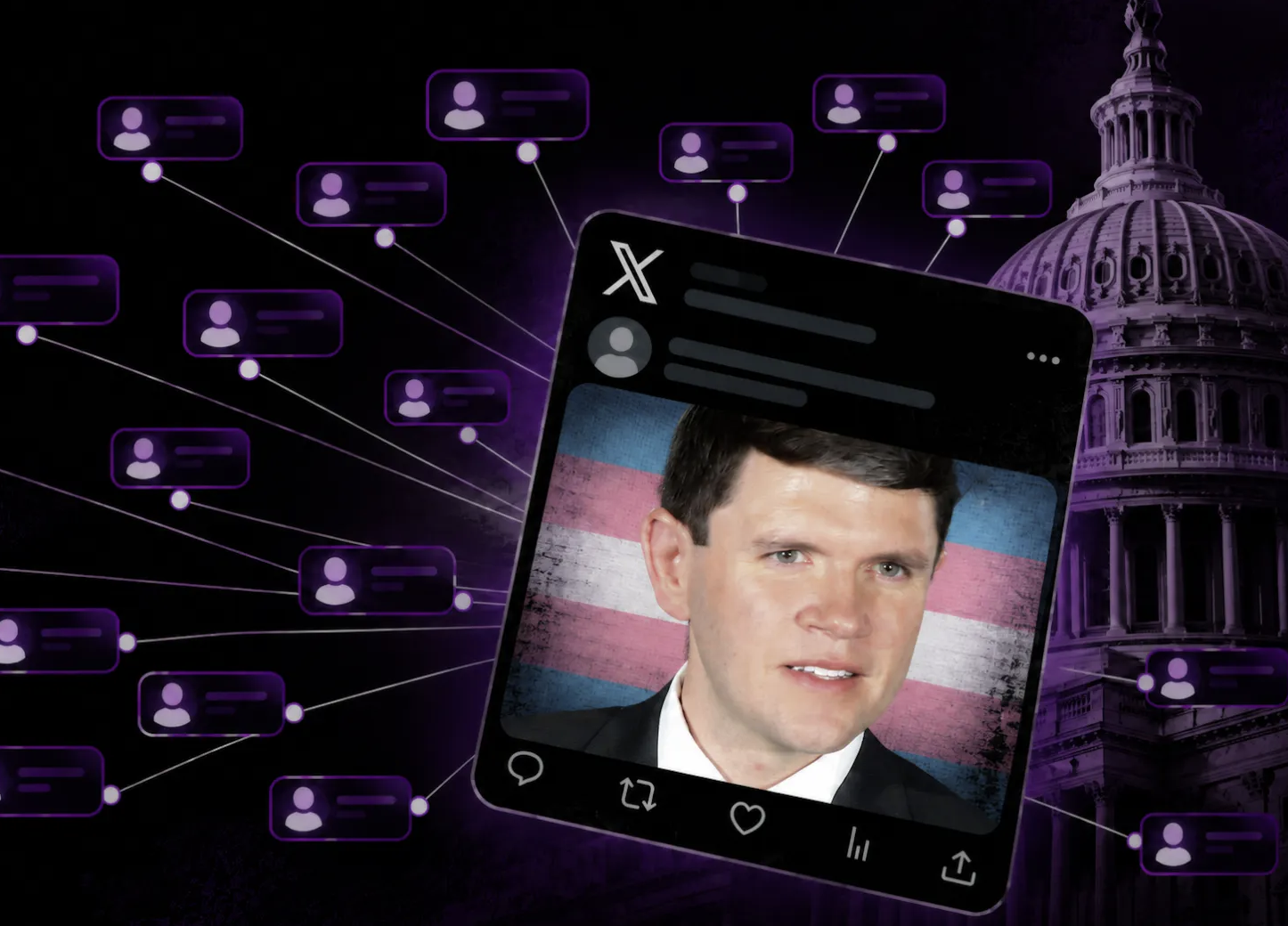
Uncloseted Media published this story on Oct. 21.
This story was reported in partnership with The 19th, a nonprofit newsroom reporting on gender, politics and policy.
By HOPE PISONI | Texas’s Senate race has become one of the most-watched elections of the year. MAGA Republican nominee Ken Paxton pulled off a rare primary defeat against a well-established 24-year incumbent, while challenger James Talarico has been polling well enough to ignite hopes of electing a Democrat to represent Texas in the Senate for the first time since 1993.
This election could have a major impact on issues like education and healthcare prices, which rank as Texas voters’ top priorities. But an outsized amount of coverage of the race has centered instead on transgender people. Paxton’s campaign and its supporters have run several AI-generated ads attacking Talarico’s pro-trans positions. That focus has shaped reporting on the race, both by right-wing media like Fox News and in mainstream outlets like The Washington Post, with many describing Talarico’s stances on trans issues as a liability. Talarico himself has walked back some of his positions in response to controversy, expressing support for some restrictions on trans athletes and rescinding a promise to co-sponsor the pro-LGBTQ+ Equality Act.
This outsized focus didn’t come out of nowhere — on March 3, when Talarico was declared the winner of the Democratic primary, there was a stunning increase in traffic on X related to his takes on trans issues.
In the three days leading up to his primary win, Uncloseted Media and The 19th could only find four posts about Talarico’s take on trans issues. But in just over 24 hours after Talarico won the primary, the newsrooms identified nearly 200 posts. Most of this was driven by three viral videos that were initially posted and amplified by GOP-affiliated politicians and strategists before being circulated by right-wing influencers, media personalities and activists. The spike shows how an army of accounts work together to amplify attacks that can shape the political debate in key races — and perpetuate harmful rhetoric.
“It is a match made in heaven, the business model of social media and people pushing hate,” Sarah Oates, a professor of communications at the University of Maryland, told Uncloseted Media and The 19th. “Because the social media companies know that these are the things that engage people.”
So how did the proliferation of this narrative happen? The following is a play-by-play of how the videos and their accompanying narrative spread in the 26 hours after Talarico’s primary win. The timeline is accompanied by analysis from experts in political communications and strategy.
What are people saying, and where did it come from?
Five minutes after election analyst Dave Wasserman calls the primary for Talarico, Republican Rep. Brandon Gill of Texas posts a clip from a 2021 debate in the Texas legislature where Talarico says that “God is nonbinary.” This is one of two clips which suddenly go viral despite having existed for years — the other, which comes from a 2021 hearing where Talarico says that there are “six really common biological sexes,” is posted by Gill the next morning to a similarly large reach. Talarico has since walked back both statements.
As Gill’s post spreads, the replies are increasingly filled with animus. In one reply, Lynn Conrad writes that “this false prophet speaks with a forked tongue and will lead many from the truth.”
Prior to Talarico’s win, these clips had gotten a small amount of media coverage and appeared in an attack ad by Terry Virts, one of Talarico’s primary opponents. However, Republicans seemingly waited to boost them further until after the primary. Matthew Sheffield, political analyst and a former right-wing political consultant, says this strategy is common.
“Sometimes candidates will decline to reveal [opposition research] that they have for other-party candidates until the general election,” Sheffield told Uncloseted Media and The 19th. “When that’s done, it’s usually because they perceive that the other-party candidate would be severely damaged by the disclosure and they actually want that person to win their party’s nomination.”
Eight minutes after Gill’s first post, the same clip is posted by Greg Price, a political consultant who held a leading role in President Donald Trump’s 2024 campaign and worked at the White House in 2025. Within the next hour, accounts with direct connections to the Republican Party and the Trump administration post the clip and spread anti-trans talking points. This includes the National Republican Senate Committee; their regional press secretary and senior adviser; and Steve Guest, Texas Sen. Ted Cruz’s former communications adviser, who posted the clip and wrote: “James Talarico is a radical trans activist who weaponizes Christianity to push a far-left agenda to mutilate children.” Overall, 12.1 percent of the posts we analyzed came from such accounts.
At least 23 other accounts go on to post Gill and Price’s version of the clips, helping their message go viral. The posts above are also reposted by accounts with millions of followers, including conservative writers Dinesh D’Souza and Ann Coulter, fundamentalist Christian radio host Jenna Ellis and an account called End Wokeness.
About an hour later, Andrew Kolvet, a spokesperson for Turning Point USA and the co-host of The Charlie Kirk Show, posts the “God is nonbinary” clip while calling Talarico a “beta male white boy” and a “compliant little lap dog.” Right-wing media figures are quick to jump on these talking points, with 18.7 percent of all the posts we analyzed coming from them.
Sheffield says that right-wing outlets scour the internet for stories that could “forward their narratives.”
“They do this not just with trans issues, they do this all the time with anyone who puts an argument forward that is helpful to them, and I personally experienced this myself,” says Sheffield, who entered into politics after his small anonymous right-wing website was covered by far-right heavyweights Rush Limbaugh and Bill O’Reilly mere days after its launch.
As the nonbinary video spreads like wildfire overnight, a new clip drops around 8 a.m. the morning after. This clip, which shows a sermon in which Talarico says that “our trans community needs abortion care too,” is the only one we analyzed which hadn’t surfaced prior to the Democratic primary. It’s first posted by ATX data, an anonymous account that bills itself as providing “conservative news and public policy covering local Austin and Texas issues.” While the account has less than 6,000 followers, the clip is picked up quickly: Fox News anchor Will Cain posts it within an hour and Kolvet and Price do so within two, allowing it to rack up over one million views.
Sheffield says that while Democratic leaders tend to prefer to establish rhetoric and positions in-house, Republican leaders more frequently look to grassroots supporters for talking points.
“That’s what this was an example of — they found something that seemed effective to conservatives, so they started picking it up and using it,” Sheffield says.
As lunchtime approaches, influencers and political commentators, who make up 18.1% of the posts analyzed, begin boosting the clips. Accounts with millions of followers, including Libs of TikTok, End Wokeness and podcast host Matt Walsh, help them go viral. The three aforementioned accounts rack up a combined 1.26 million views on their posts about Talarico.
Ashley St. Clair, the mother of a child with Elon Musk and a former MAGA influencer who has since left the right-wing online ecosystem and has spoken out about its “very coordinated” nature, says influencers are incentivized to repost right-wing talking points with momentum on social media because they can make bank from ad revenue, brand deals and practices like paid retweets.
“I worked with [Libs of TikTok], and that’s a business where she makes money hand over fist from this type of content,” St. Clair told Uncloseted Media and The 19th. “It’s become an obsession where she spends all day scouring the dark corners of the internet to make a minority seem like the rule.”
Libs of TikTok did not respond to a request for comment.
Between 10 p.m. on March 3 and 11 a.m. on March 4, Uncloseted Media and The 19th identified 48 posts about Talarico that use similar anti-trans talking points, including 26 separate posts of the three clips that would amass millions of combined views. In contrast, we identified zero pro-trans posts about Talarico in the same time period. Oates finds this sharp turn in the discussion suspicious.
“When you see a shift in a discourse on a particular platform that’s quite abrupt and moves from one side to another and then stifles all dissent, that’s generally gonna be inauthentic,” she says. “That’s generally gonna be led by people who are pushing propaganda or political messaging. … It’s not reflective of general public opinion on the issue.”
This perspective reflects statements by St. Clair. She told the Washington Post that she joined large group chats where influencers would receive “marching orders” from the Trump administration and congressional Republicans. She also shared direct messages with The Post that showed White House staffers asking her to boost talking points and Republican strategists offering her money to amplify posts. Based on Uncloseted Media and The 19th’s findings, she says it’s likely that the anti-trans attacks against Talarico were coordinated in this way.
“I’d be willing to bet there was money put behind it in a paid campaign, because this is how MAGA operates,” St. Clair says. “Most people don’t understand that a lot of these MAGA influencers have access to a dashboard through certain companies where they can just log on and see any campaign that they can sign on to … and all they have to do is push out messaging, which means they don’t have to disclose that they’re paid.”
Sheffield says that many right-wing actors have such closely aligned interests that they don’t need to work together to act in concert.
“Probably most of it is not intentional when you see something go big,” Sheffield says. “They all have a movement mentality on the right, so when they see something that looks effective, then they’re gonna repeat it.”
As the morning progresses, the same talking points are adapted to French, Portuguese and Spanish, the last of which 28.5 percent of Texans speak at home. Like in English, they’re primarily spread by right-wing actors, including political strategist Emmanuel Rincon, who has nearly 620,000 followers on X and is the first to post the sermon clip to a Spanish-speaking audience. By the end of the day, the Spanish news media had also picked up the story.
One especially viral post comes from Collin Rugg, co-owner of the right-wing news site Trending Politics. Rugg stitches together a video that includes numerous clips of Talarico speaking on different topics, including the three trans-focused clips. In his post, he incorrectly says that Talarico claimed there were six genders rather than “biological sexes,” a misquote later repeated in an article by the Daily Caller, Fox News anchor John Roberts, and later Trump.
Matthias Kettemann, a professor of internet law at the University of Innsbruck in Austria, says that social media optimized for engagement allows misinformation to spread easily.
“Untrue information is usually more emotionally charged, and therefore there is a prima facie advantage,” Kettemann told Uncloseted Media and The 19th.
Shortly after noon, these posts begin moving outside of X and social media. The Charlie Kirk Show, broadcast on the streaming and cable channel Real America’s Voice, airs the nonbinary and six sexes clips. Later in the day, anti-trans talking points about Talarico make it onto Newsmax’s “The Big Take,” “Ed Henry: The Briefing,” and “The Pulse” as well as Fox News’ “The Will Cain Show.” By 8:30 p.m., “Jesse Watters Primetime,” which is the second most-watched cable news show in America, discusses Talarico’s stances on trans issues to an audience of roughly 4 million.
Shortly after the clips air on The Charlie Kirk Show, the conservative print media starts picking them up. At 12:35 p.m., the Washington Examiner publishes an article titled “FLASHBACK: James Talarico said there are six sexes while opposing ban on men in women’s sports.” Later in the afternoon, the Daily Caller, the Daily Signal, The Gateway Pundit, and Voz all post articles about the clips, with three of them citing X posts from earlier in the day.
Howard Polskin, president and founder of TheRighting, a website that tracks and analyzes right-wing media, says that right-wing social media and traditional media narratives tend to support each other.
“It’s a virtuous cycle,” Polskin told Uncloseted Media and The 19th. “If something gets written about in an extremist right-wing website, it might be posted on social media, then more social media outlets will pick that up and it might go viral.”
Matt Whitlock, a former senior adviser to the National Republican Senate Committee and the current senior vice president at CRC advisers, a PR firm known for serving conservative organizations, plays a key role in getting these anti-trans talking points on TV. He is the first one to introduce them on Fox News and Newsmax.
“The problem for [Talarico] is he’s created so much incredible ad content already that if you look at [X] today, it is flooded with clips of [him] saying absolutely insane things,” Whitlock told the host of The Big Take on Newsmax.
Whitlock uses the fact that social media is “flooded” with clips of Talarico advocating for trans rights to legitimize his claims that Talarico is an unviable candidate, despite the fact that right-wing operatives like himself are the main ones responsible for the spread of those clips. Oates says this reflects a common strategy in propaganda campaigns.
“Social media has the opportunity to spread more outrage more widely and more freely, but it’s not as influential as mainstream media,” Oates says. “What’s worrying is when what’s going on on social media starts to shape discourse in the more influential mainstream media. … ‘The people are saying’ is a classic propaganda gambit.”
Whitlock did not respond to a request for comment.
What to make of this
All told, we tracked 182 anti-trans posts attacking Talarico on X in the 26 hours after he won the primary. Sixty-three included or referenced the nonbinary clip, 50 referenced the sermon clip and 35 referenced the sexes clip. Between these posts and the citations in the right-wing media, the talking points targeting Talarico’s pro-trans positions likely reached over 10 million people.
In the leadup to the midterms, some Democrats have walked back their positions on trans rights — candidates have come out against gender-affirming care for minors and trans inclusion in bathrooms or sports, with one Ohio representative running an ad opposing “gender ideology” in schools.
Oates says that the manufactured nature of this spread indicates that these anti-trans positions do not accurately reflect the feelings of the voter base. A recent poll of American adults by The 19th and YouGov found that 37 percent of respondents think that both Democrats and Republicans talk about trans issues too much, and trans issues ranked the lowest in terms of importance among respondents to a September CNN poll.
“It’s understandable that some politicians would limit what they say about trans rights, but I think it’s misguided,” Oates says.
Despite how successful these social media tactics can be for Republicans, Democrats rarely follow suit. Oates attributes this to the fact that Democratic narratives tend to be more factual and less inflammatory, making them less suited to virality. Kettemann adds that research has found that right-leaning people tend to be slightly more susceptible to online misinformation.
“There have been few examples of campaigns like you’ve described coming from the left,” he says. “One of the reasons is that people from the left, by and large, are more technologically savvy and don’t fall into the trap of this kind of messaging.”
These tactics endanger trans people
The spread of these posts endangers trans people. The spike in anti-trans rhetoric in the 2020s has increased rates of poor mental health and suicidality among trans people and incited violence against the community. Oates says X’s algorithm rewards hateful content, especially since Elon Musk removed several guardrails for content moderation, including replacing the site’s independent fact-checkers with a volunteer-based community note system.
Social media platforms have increasingly come under fire for the harmful consequences of their engagement-focused algorithms. In the U.S., legal accountability for tech platforms can be difficult to achieve due to laws protecting them from being liable for content on their websites. But in their current state, Oates says that social media platforms like X are not healthy for democracy.
“By participating [on X], you’re not participating in real civic discourse, you’re being used as a commodity by a social media company that not only doesn’t have your best interests at heart but is deliberately trying to inculcate hatred.”
Oates believes that moving beyond the midterms, we will see one of two paths in American politics: “One in which political power is defined by … campaign[ing] on fear,” and another where “people decide … to embrace news and information that’s actually based in reality.”
Additional data reporting by Andrew Norris.
California
Nithya Raman makes her case for LGBTQ voters in the race for LA Mayor
The mayoral candidate said she would use ‘every tool that the city has to protect trans Angelenos’
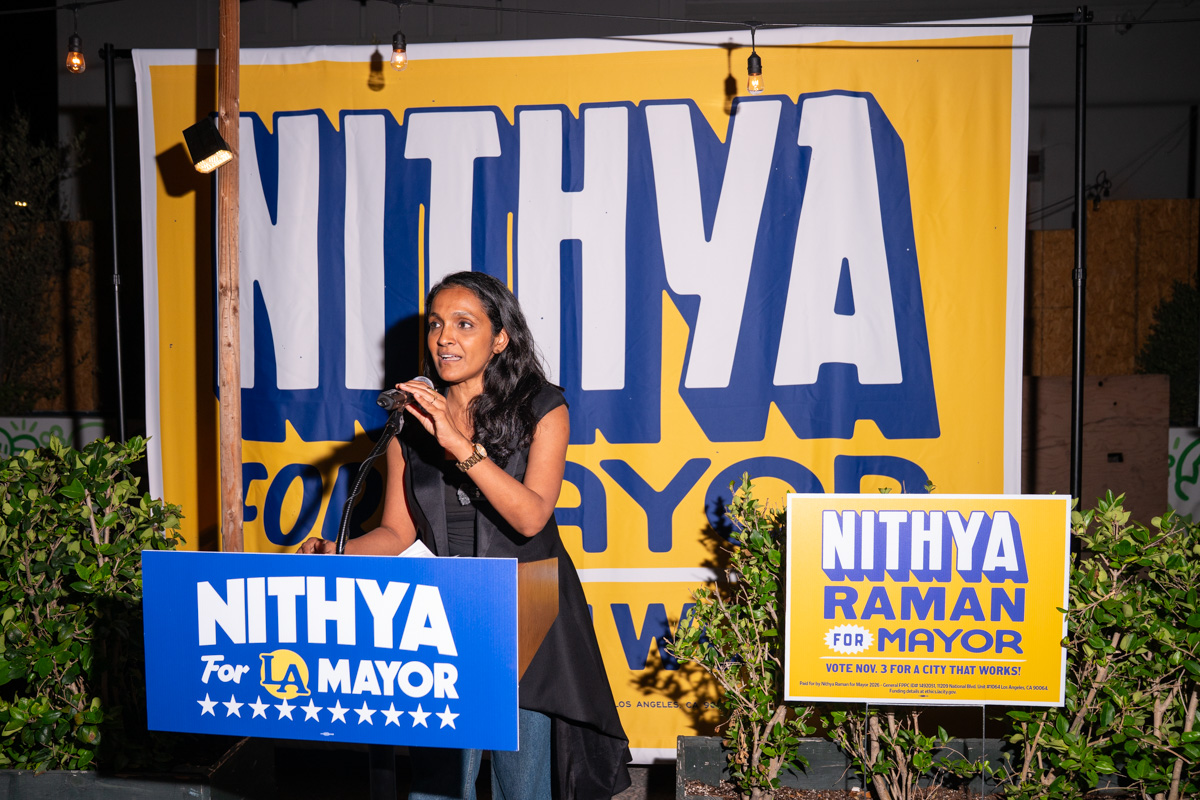
On a cool evening, around a hundred people gathered at the Black Cat’s outdoor seating area in Silverlake. The crowd was full of precisely trimmed mustaches, sleeveless cardigans, and colorful rainbow pins that read “Nithya Raman for Mayor of Los Angeles.”
This was the “Coming out for Nithya” LGBTQ fundraiser for Nithya Raman’s mayoral campaign.
The event which took place on October 8th, was hosted by gay comedian Joel Kim Booster and Pickles the Drag Queen. The pair encouraged the queer audience to support Raman and to donate money to her campaign. The event ended with over $20,000 raised to support Raman according to an organizer of the fundraiser.
Raman is locked in a tight race to become the next mayor of Los Angeles with current incumbent Karen Bass. After coming second in the mayoral primary in August, defeating right-wing provocateur and former reality TV star Spencer Pratt, Raman and Bass advanced to the general election. Since then, current City Councilmember Raman has been steadily gaining in the polls, with most showing her now maintaining a consistent lead over Bass. But the race is far from over, as many of the same polls show a large portion of voters are still undecided. Mayor Bass did not respond to multiple requests to comment on this story.
After an hour of the audience ordering drinks and snacking on appetizers, Raman took the stage. She addressed the audience in an impassioned speech where she invoked the history of the historic Black Cat venue where the event was taking place.
In the early hours of New Year’s Day 1967, undercover police officers raided the gay bar, arresting and beating patrons for kissing people of the same gender as the new year rolled in. The raid left many queer community members badly injured, and others were permanently placed on the sex offender registry. The bar would soon have its liquor license revoked and was forced to close only a few months later.
“Six weeks after the raid, hundreds of people stood right where we are right now on Sunset [Avenue] and peacefully protested,” Raman said in her speech. “In 1967 being seen on that sidewalk could cost you your job, it could cost you your home, it could cost you your family, and they showed up anyways,” she said. “How remarkably brave.”
She then tied the historic oppression of queer people in Los Angeles to contemporary issues, highlighting the Trump-Vance administration’s targeting of transgender people. “Right now, Donald Trump and the people around him are running a coordinated attack on trans people,” she said. Raman remarked on how this targeting of trans people has impacted Los Angeles. “Last year, under pressure from the Federal government, Children’s Hospital Los Angeles shut down the largest clinic for trans youth in the country,” she said, referring to Children’s Hospital Los Angeles’ decision to suspend gender affirming care services.
“As mayor, I will use every tool that the city has to protect trans Angelenos,” Raman said to ecstatic applause from the audience.
After her speech, Raman spoke with the Los Angeles Blade about the specific actions she would take to protect Angelenos from the federal government.
According to Raman, the federal administration is conditioning funding to the city “in ways that undercut some of the values of inclusiveness that we have here,” she said. “Going through the courts is very powerful… I would do more of that. This city has actually not filed as many cases as other cities have.”
Speaking about CHLA’s ending of gender affirming care services, Raman said, “There are other hospitals that have not stepped back from their services as quickly as CHLA did.” If elected as Mayor, Raman said she would “reach out to their board and speak to them about that decision and see how we can push them to do better [for] trans patients,” she said, adding that she doesn’t think “that outreach has happened yet” under Mayor Bass’ administration.
She added that her campaign’s focus on affordability and affordable housing is particularly important for queer people. She said that if elected, she would create “an office of tenant protections” to help renters most vulnerable to being priced out of the city.
“Housing is what makes LA a haven for people,” Raman said. “If you can’t afford to live here, then LA is not a place that is inclusive anymore.”
Caleb Kaufman is a California Local News Fellow placed with the Los Angeles Blade. The California Local News Fellowship is a state-funded initiative to support and strengthen local news reporting. Learn more about it at fellowships.journalism.berkeley.edu/cafellows.
Federal Government
EXCLUSIVE: Democrats seek answers on EEOC settlement affecting LGBTQ+ workers
Bobby Scott and Mark Takano want clarification on anti-discrimination protections

The U.S. Equal Employment Opportunity Commission agreed in August to a settlement with the Christian Employers Alliance that could limit the agency’s ability to pursue certain workplace discrimination claims involving gender identity. Now, Democratic lawmakers are questioning how far the agreement reaches — and whether it could constrain the commission’s enforcement decisions for years to come.
The Los Angeles Blade obtained an early version of a letter from U.S. Reps. Bobby Scott (D-Va.), the ranking member of the House Education and the Workforce Committee, and Mark Takano (D-Calif.), raising concerns about the settlement and its potential implications for workplace protections.
The agreement stems from a lawsuit the CEA filed challenging the Biden-Harris administration’s EEOC guidance on workplace harassment; including protections involving gender identity, pronouns, dress codes, and access to bathrooms and other facilities. The CEA argued that the guidance infringed on its members’ religious rights.
Under the settlement, the EEOC agreed not to pursue certain charges based on gender identity discrimination against the CEA and its member organizations. The agreement also covers future CEA members, provided the alleged conduct occurred while the employer was a member of the organization, raising questions about whether employers could receive protections from agency enforcement by joining the alliance.
Two Democratic congressional aides familiar with the EEOC’s work and workplace protections, who spoke to the Blade on the condition that they remain anonymous, said the agreement could restrict the commission’s ability to pursue discrimination complaints and potentially tie the hands of future administrations.
“They’re sort of swearing not to go after it and not exercising their own discretion, but they’re also purporting to bind future administrations with respect to exercising that discretion,” one aide said.
The aide said the agreement raises constitutional questions about whether the current administration can limit how future administrations exercise the EEOC’s enforcement authority.
In their letter to EEOC Chair Andrea R. Lucas, Scott and Takano question the legal authority for an agreement that they say would prevent future administrations from pursuing certain claims. They cite a 1986 Justice Department legal opinion concerning settlement agreements that constrain the discretion of future administrations and ask Lucas to explain the legal basis for the EEOC’s decision.
The lawmakers also ask whether the commission has entered into similar agreements, whether other federal agencies were consulted and whether the EEOC believes there are limits to its authority to make such commitments.
Scott also criticized the EEOC’s handling of workplace discrimination involving transgender and nonbinary people, arguing that the commission has failed to uphold its responsibilities under federal law.
“Discrimination against transgender and nonbinary people is a serious and ongoing issue. A recent survey found that despite the Bostock decision, 27 percent of transgender people experienced workplace discrimination in the past year. The EEOC was created under Title VII of the Civil Right Act of 1964 and charged with addressing discrimination against workers. Yet, under Chair Lucas’s leadership, the EEOC has abdicated this responsibility under the law when it comes to transgender and nonbinary workers,” said Scott.
The commission’s fiscal year 2026 litigation filings also reflect a shift in its enforcement priorities. The agency’s lawsuits largely tracked its National Enforcement Plan, which emphasizes religious discrimination, alleged anti-American bias, protections for women and purportedly unlawful diversity, equity, and inclusion practices.
The EEOC filed 16 religion-based lawsuits, pursued several cases involving alleged discrimination against majority-group members and continued to bring pregnancy and sex discrimination claims. However, its filings included no lawsuits brought on behalf of LGBTQ+ employees, underscoring questions about how the commission is prioritizing workplace discrimination claims under Lucas’s leadership. The filings suggest the NEP has served as a roadmap for the agency’s litigation decisions, rather than merely a statement of policy priorities.
The letter raises a further concern: whether the agreement could allow employers to obtain protection from certain discrimination claims simply by joining the CEA.
The congressional aides questioned what safeguards would prevent employers from joining the alliance primarily to shield themselves from discrimination claims, rather than because of a genuine commitment to the organization’s stated religious principles.
“What kind of oversight is going to exist to even ensure that these future employers who join […] could just lie, right?” one aide said, questioning whether employers could claim to share the CEA’s beliefs while seeking liability protection.
The aides also raised concerns about the financial incentives the agreement could create for the organization as it recruits new members.
“It’s more than a little gross that this alliance is attracting other employers to join their alliance and making a buck off of workers’ discriminations, you know, complaints not being adjudicated by EEOC,” one aide said.
Scott and Takano are asking the EEOC to explain what requirements employers must meet to qualify for CEA membership and what safeguards will ensure they continue to meet those criteria. They also want to know how the agency will handle complaints involving multiple forms of alleged discrimination when only some fall within the settlement’s terms.
The agreement does not prevent workers from filing complaints with the EEOC, according to the congressional aides. Workers may also retain the ability to pursue private lawsuits. But the aides said employees could lose the commission’s support in cases the settlement prevents it from pursuing.
“They will still have the right to bring private lawsuits, they just won’t have the EEOC in their corner,” one aide said.
The lawmakers are seeking answers about what happens when an employee files a complaint against a CEA-member employer and the employer claims the case is covered by the settlement. They ask how quickly the EEOC would issue a right-to-sue notice in such circumstances and whether workers would be told that the settlement was the reason the agency did not pursue their cases.
The letter also asks whether the EEOC has developed — or plans to develop — notices explaining when an investigation is closed or partially closed because of the agreement.
The aides said the agreement’s precise scope remains unclear, including how it could affect complaints involving conduct beyond the specific issues challenged in the CEA’s lawsuit. They also questioned whether its implications could extend to other forms of sex-based discrimination, such as discrimination based on an employee’s appearance or failure to conform to gender stereotypes.
“The scope of this seems really big. Well, actually, it seems undefined, which is really the scary part,” one aide said.
The lawmakers are also seeking information about the role of EEOC Chief of Staff Shannon Royce, who, according to the letter, was CEA president when the organization filed its lawsuit. They ask whether Royce participated in the settlement process, whether she recused herself and whether the commission will provide records of relevant communications and meetings.
Scott and Takano are requesting quarterly reports on the number of investigations involving the CEA and its members that the EEOC closes because they fall within the settlement’s terms. The aides said the letter is intended to establish a record of the lawmakers’ concerns and signal that they intend to continue scrutinizing the agreement.
One aide warned that the settlement could contribute to a broader chilling effect on LGBTQ+ workers.
“I think this is one more move by this administration to shove people back in the closet,” the aide said.
The Blade contacted the EEOC on Friday seeking comment on the settlement’s implications for workplace protections and responses to the questions raised by Scott and Takano. The EEOC has yet to respond.
Brazil
VIDEO: Interview with executive director of VoteLGBT (Institute for Full Citizenship) in Brazil
Second round of presidential election taking place on Sunday
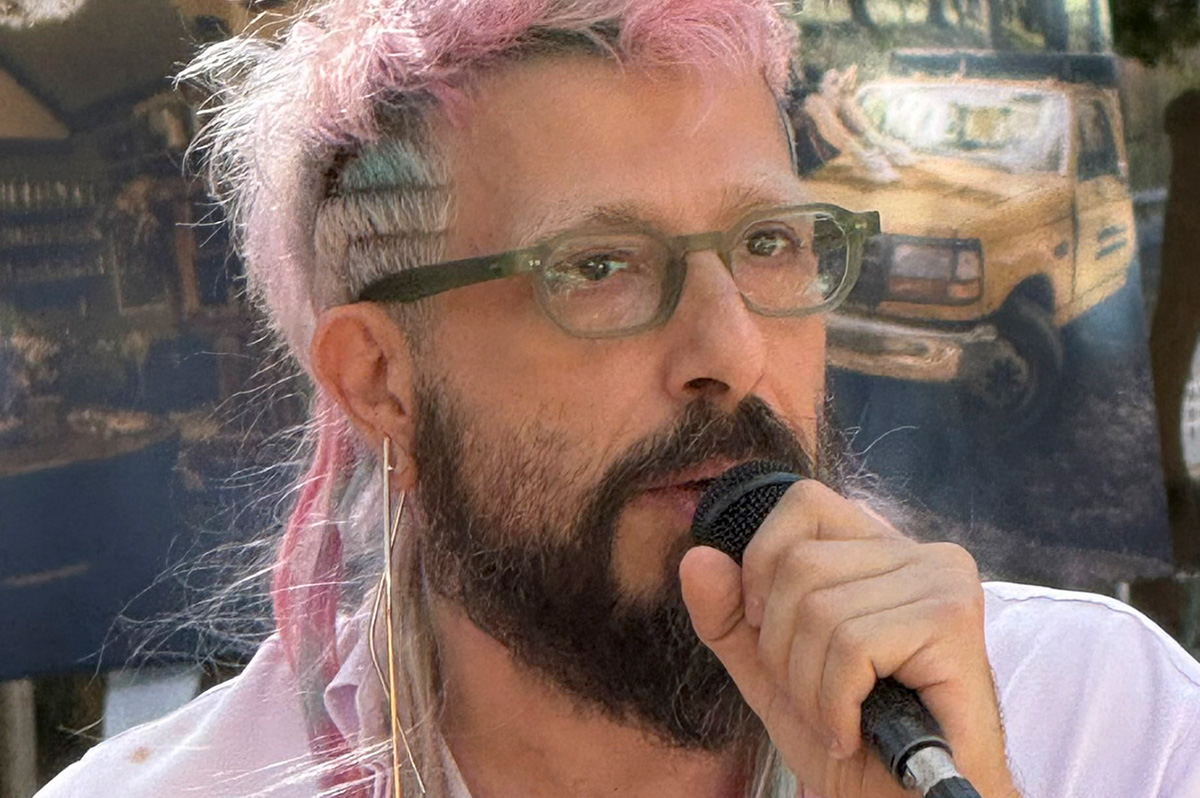
The Los Angeles Blade on Monday spoke with Gui Molhallem, the executive director of VoteLGBT (Institute for Full Citizenship), a group that seeks to increase LGBTQ+ and intersex representation in Brazilian politics.
Molhallem pointed out 35 LGBTQ+ candidates won their respective races in the Oct. 4 election. They include Natal Municipal Councilwoman Thabatta Pimenta, a member of the Green Party who became the first transgender woman from northeast Brazil elected to represent Rio Grande do Norte state in the country’s Chamber of Deputies.
Congresswoman Erika Hilton, a travesti member of the leftist Socialism and Liberty (PSOL) party on Oct. 4 won re-election with nearly 1.6 million votes, the most any female member of Congress has received in Brazilian history. Guilherme Cortes, a bisexual PSOL member from São Paulo state, and Rick Azevedo, a gay PSOL member from Rio de Janeiro state, are among the candidates who won their respective Chamber of Deputies races.

Samanda de Lula, a lesbian member of the leftist Workers’ Party, will represent Rio Grande do Norte in the Brazilian Senate.
Molhallem pointed out there will be 14 openly LGBTQ+ members of Congress once the candidates who won their races on Oct. 4 take office in February. This number is the highest of any country in the Americas.
President Luiz Inácio Lula da Silva will face off against Sen. Flávio Bolsonaro in the second round of the presidential election on Sunday after neither man received at least 50 percent of the vote on Oct. 4.

Lula, who leads the Workers’ Party, in 2022 defeated Bolsonaro’s father, then-President Jair Bolsonaro, in that year’s presidential election.
The Brazilian Supreme Court last year sentenced Jair Bolsonaro — who repeatedly targeted LGBTQ+ Brazilians and other groups while in office — to more than 27 years in prison for his role in an attempted coup that saw thousands of his supporters storm the Congress, presidential palace, and the Supreme Court itself on Jan. 8, 2023. Jair Bolsonaro is currently serving his sentence at his home in Brasília, the country’s capital, because of his poor health.
His son has pledged to pardon him if he becomes the country’s next president.
(Video by Michael K. Lavers for the Washington Blade)
AIDS and HIV
AIDS Walk Los Angeles takes to the streets in West Hollywood while raising money for HIV/AIDS Care
The annual fundraising event was attended by thousands and raised over $850,000

Hundreds of yellow shirts and thousands of people took over the streets of West Hollywood during AIDS Walk Los Angeles on Sunday, October 18th. Organized by APLA Health, the event raised over $850,000 for HIV/AIDS healthcare and prevention. Oakwood School raised the most money of any organization, with over $62,000 in donations.
Before the march began, participants gathered at West Hollywood Park, where speakers addressed the crowd from a large main stage. City officials and celebrity guests spoke before the march began, including Mayor John Heilman, County Supervisor Lindsay Horvath, comedian Joel Kim Booster, and singer David Archuleta.
CEO of APLA Health, Craig E. Thompson, took the stage and addressed the state of HIV and AIDS care in America. He spoke about the first AIDS Walk LA in 1985, which began when there was a “federal administration that stayed silent when thousands of our friends, partners, and neighbors were dying.” “We’ve been there before, and here we are again,” he said, referring to the federal cuts to HIV prevention programs, Medicaid, and more. According to Thompson, Medicare provides more healthcare to more people living with HIV than any other provider.
But despite these federal cuts, Thompson was hopeful for the future of HIV care, drawing on lessons learned early on in the epidemic by the original AIDS activists. “We didn’t wait for permission,” he said. “We showed up, we raised our voices, we walked, and we protected our community.”
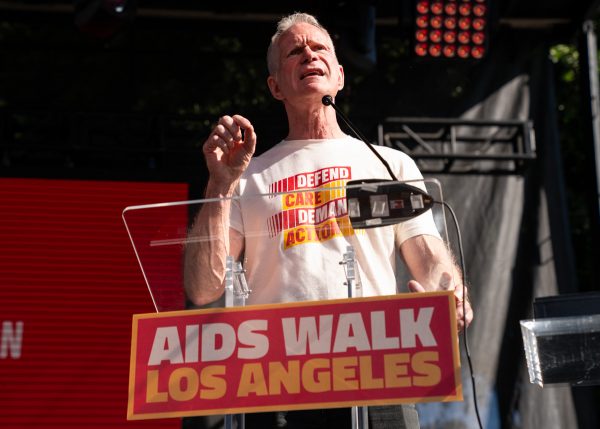
APLA Health CEO Craig E. Thompson speaks at AIDS Walk Los Angeles in West Hollywood Park on Sunday, October 18th, 2026.
Actress Michaela Jaé Rodriguez was honored with the first-ever Voice of Visibility Award for her work fighting stigma around HIV and AIDS. Known for her Golden Globe-winning performance as Blanca Evangelista in Pose, Rodriguez told the crowd that those living with HIV “are not statistics.”
“We are not disposable. Instead we’re daughters. We’re mothers. We’re sisters. We’re brothers. We’re fathers. We’re artists. We’re creators. We’re actors. We’re award winners,” she said to a roaring audience.
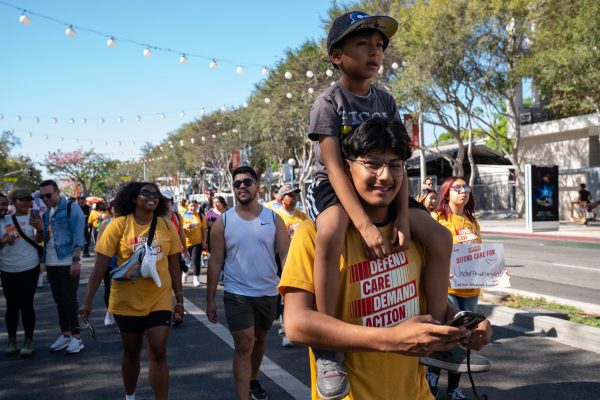
People walk down Santa Monica Boulevard during AIDS Walk Los Angeles on Sunday, October 18th, 2026.
The mood was joyful as the walk began. Many people carried signs with the names of loved ones living with HIV. Multiple musical groups performed, including a drumline, a pep band, and a mariachi group. People laughed, cheered, and danced as they strutted up and down Santa Monica Boulevard.
As the walk looped back to West Hollywood Park, people sat around talking with friends and community members. I walked past the lines for free ice cream and flu shots and wandered over to the AIDS Monument, which opened recently in 2025. Designed by artist Daniel Tobin, the monument is unlike most others. It is abstract, made up of tall and narrow metal poles and marble blocks.
A young tour guide in a baseball cap and chic sunglasses was giving a tour of the monument to a group of about five people. The guide’s name was Jude Schoenfeld, the Director of Public Programs for One Institute. Schoenfeld spoke, and the group walked through the metal beams emerging from the ground. At first, the poles were spread out organically like trees in a forest, but as the group wandered further, they unified into an organized grid towards the far end of the monument. This is where they stopped.
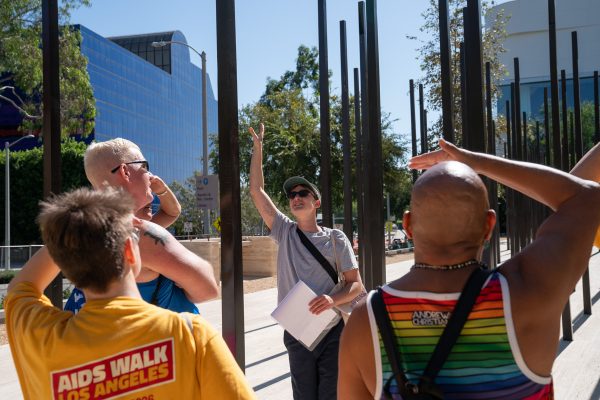
Jude Schoenfeld gives a tour at STORIES: The AIDS Monument after AIDS Walk Los Angeles in West Hollywood Park on Sunday, October 18th, 2026.
Quotes from the gay poets Gil Cuadros and Essex Hemphill were inscribed on a bronze plaque. Schoenfeld read them and remarked on how the artists died so young from complications with AIDS, both passing away in their late thirties. An older member of the tour group interjected, saying that living that long actually felt old for gay men at the time. “No one from that era that was gay expected to live beyond forty. We thought we were all gonna die of AIDS,” he said. “So thirties, that’s a whole life. We lost everybody when they were in their twenties.”
After the tour ended, I asked Schoenfeld what it’s like to give tours to people who lived through the early years of the AIDS epidemic, when you could lose a friend in a few months with hardly any warning. “Oftentimes, it’s emotional for people to be here,” they told me. “The great aspect of the tours is that they become a conversation and a place for folks to share memories.”
“People who’ve been in Los Angeles and West Hollywood for decades have just such a rich understanding of the history here. I’ve learned so much from just talking to folks who come on the tours,” Schoenfeld told me.
As we stood next to the monument with music blasting and kids playing a few hundred feet away, Schoenfeld told me about why they think it’s so important to learn the history of AIDS activism. “It’s never been more important,” they told me. “Especially as we’re seeing threats all around from different institutions that want to take funding away and want to take these resources that we’ve spent so long building.”
“I think this is a really important juncture in history,” they said. “We want this to be a site of continued activism.”
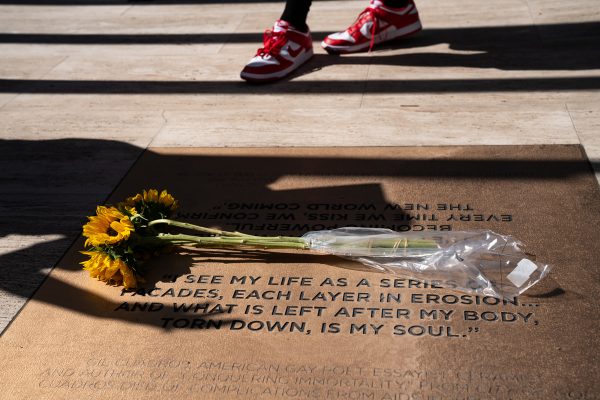
Flowers are laid on a plaque at STORIES: The AIDS Monument in West Hollywood Park on Sunday, October 18th, 2026.
Puerto Rico
Annual National Trans Visibility March takes place in Puerto Rico
Participants highlighted anti-trans laws in U.S. commonwealth
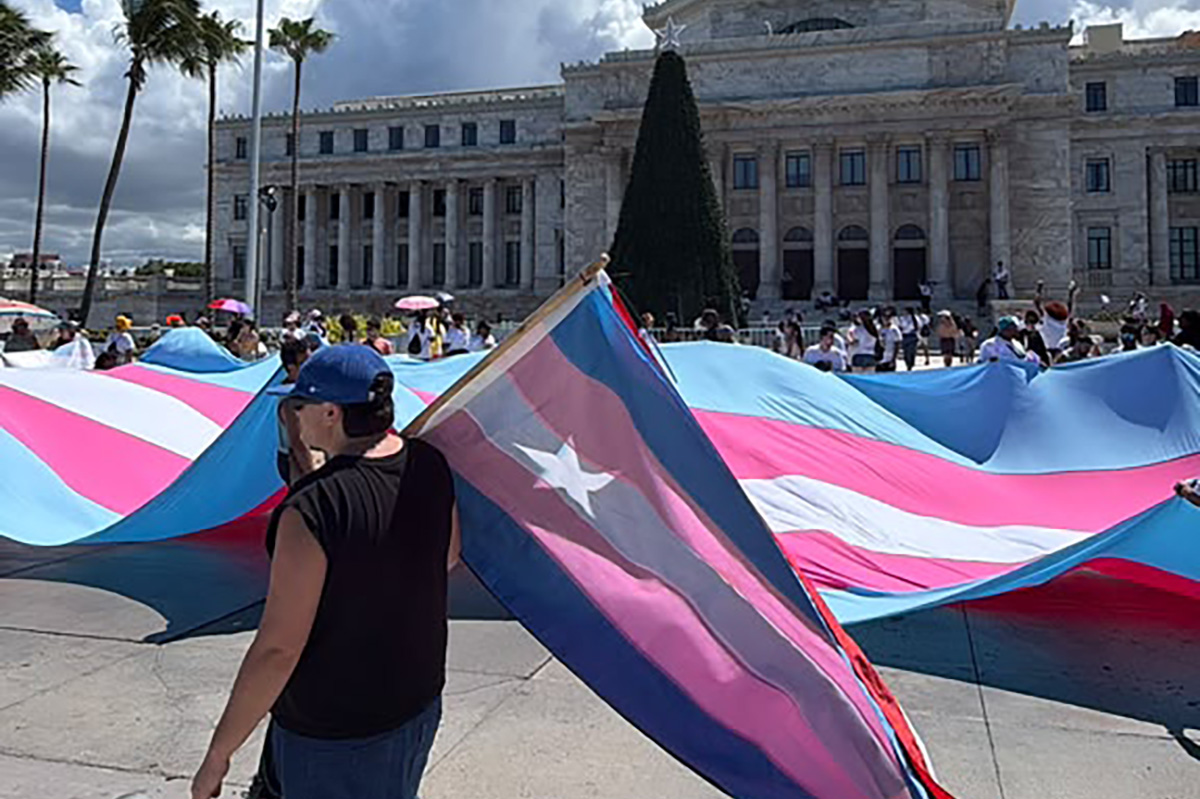
The annual National Trans Visibility March took place in Puerto Rico on Saturday.
The march ended at the Puerto Rican Capitol in San Juan, the U.S. commonwealth’s capital and largest city. Samy Nemir Olivares, a member of the Puerto Rico LGBTQ+ Federation’s board of directors who also works for Lambda Legal, is among those who spoke.
The march took place at the end of a three-day conference that took place in San Juan. Participants included:
• Ana Irma Rivera-Lassen, the first openly LGBTQ+ person elected to the Puerto Rican Senate
• Mila Hellfyre, a trans Puerto Rican activist
• Maru Rosa Hernández, a nonbinary plaintiff in Lambda Legal’s lawsuit that challenges the Puerto Rican government’s refusal to issue birth certificates with an “X” gender marker
• Peter Manuel Shepard Rivas, a Puerto Rican HIV/AIDS activist
• Lambda Legal Senior Counsel and Health Care Strategist Omar González-Pagán
Waves Ahead, Puerto Rico’s largest LGBTQ+ organization, is among the groups that sponsored the National Trans Visibility March and conference. Other sponsors included the TransLatin@ Coalition, the True Self Foundation, the Transgender Law Center, Advocates for Trans Equality, Human Rights Campaign, Gilead, the Georgetown University Law Center’s O’Neill Institute for National and Global Health Law, GLAAD, and the Hispanic Federation.
“Now it’s more important than ever to unite as an LGBTQ+ movement alongside our allies to protect the progress we have made in achieving trans and queer rights as both the federal and local governments attempt to erase and criminalize our identities,” said Olivares. “The president insists that trans identities don’t exist, yet they continue to attack our rights and existence through the laws.”
“But we are here, we are not going to be silenced or erased,” added Olivares. “As (with) any other Americans, trans and queer people deserve equal access to healthcare, housing, and nondiscrimination at the workplace and government services.”
Olivares in their comments noted the Puerto Rican government “has betrayed and undermined the LGBTQ community by signing into law more than” half a dozen anti-LGBTQ+ laws.
True Self Foundation Executive Director Miguel Vázquez-Rivera during a Congressional Hispanic Caucus briefing earlier this year noted these include a ban on gender-affirming healthcare for anyone under 21. Vázquez-Rivera also highlighted Law 26-2026, which prohibits the University of Puerto Rico and other “government facilities” from installing “mixed or gender-neutral multi-occupancy restrooms.”
Puerto Rico Gov. Jenniffer González, a Republican who is a member of the pro-statehood New Progressive Party, signed these laws after she took office in January 2025. González, who supports President Donald Trump, was Puerto Rico’s resident commissioner in the U.S. House of Representatives before she became governor.
Olivares told the Los Angeles Blade that National Trans Visibility March organizers decided to hold the annual event in Puerto Rico as a way to highlight the fact the commonwealth has “the most severe anti-trans legislation in the U.S.” and to stand in solidarity with local activists.
The first National Trans Visibility March took place in D.C. in 2019. Next year’s National Trans Visibility March is scheduled to take place in Atlanta.
Immunology gave HIV survivors the chance to grow old, Proposition 38 is the next step

Common Sense Isn’t Political

‘WOOF’ worthy: Christopher Schellenger shares the unique challenges of playing a dog

Here’s your Palm Springs look at the weekend: Oct 23 – 25, 2026

Latin queer and trans history along the U.S.- Mexico border on display at UC Riverside event

EXCLUSIVE: Democrats seek answers on EEOC settlement affecting LGBTQ+ workers

VIDEO: Interview with executive director of VoteLGBT (Institute for Full Citizenship) in Brazil

Annual National Trans Visibility March takes place in Puerto Rico

AIDS Walk Los Angeles takes to the streets in West Hollywood while raising money for HIV/AIDS Care

Nithya Raman makes her case for LGBTQ voters in the race for LA Mayor
-
 Federal Government4 days ago
EXCLUSIVE: Democrats seek answers on EEOC settlement affecting LGBTQ+ workers
-
 Brazil4 days ago
VIDEO: Interview with executive director of VoteLGBT (Institute for Full Citizenship) in Brazil
-
 Puerto Rico5 days ago
Annual National Trans Visibility March takes place in Puerto Rico
-
 AIDS and HIV5 days ago
AIDS Walk Los Angeles takes to the streets in West Hollywood while raising money for HIV/AIDS Care
-
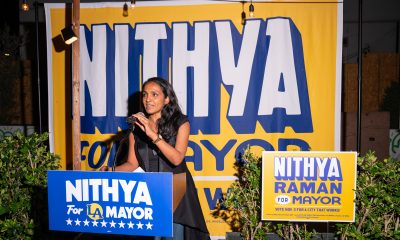 California4 days ago
Nithya Raman makes her case for LGBTQ voters in the race for LA Mayor
-
 Commentary3 days ago
Those dreadful ballot propositions are important
-
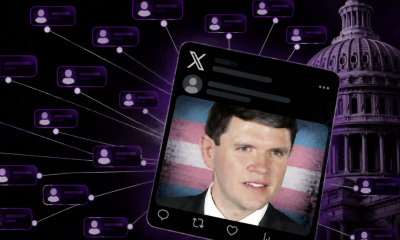
 Texas3 days ago
How anti-trans backlash to James Talarico spread like wildfire
-
 Palm Springs1 day ago
Here’s your Palm Springs look at the weekend: Oct 23 – 25, 2026
-
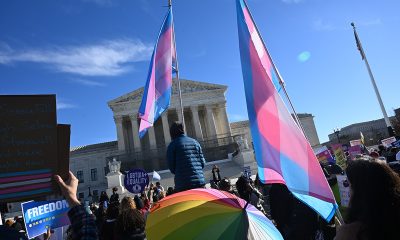
 U.S. Supreme Court3 days ago
Supreme Court blocks White House anti-trans prison policy
-
 Business4 days ago
Minding more than our own business: Marquita Thomas dishes on queer entrepreneurship amping up for the LGBTQ Mega Mixer