
Politics
Buttigieg thrills supporters at campaign event at The Abbey (partial transcript)


West Hollywood is far from anywhere in Iowa, home of the first-in-the-nation caucuses next February. The New Hampshire, Nevada and South Carolina electoral contests follow in quick succession helping determine which of the 21 declared Democratic candidates will challenge anti-LGBT Republican Donald Trump in his bid to win re-election in 2020.
But as The Abbey filled up with a sold-out crowd of 700 energized LGBT and ally grassroots voters excited to see Pete Buttigieg—the 37-year old gay married Christian breakout Democratic contender—it was clear that West Hollywood could well become ground zero for a massive Los Angeles get-out-the-vote effort in the critical March 3, Super Tuesday, California primary.
Buttigieg seemed keenly aware of the historic mantle passed to him by, among others, assassinated gay San Francisco Supervisor Harvey Milk who pressed the message of hope in times as dark as these. To roars of delight, the mayor of South Bend, Indiana, was introduced by his husband, Chasten Glezman.

Chasten Glezman (Photo courtesy The Abbey & Food)
“Five years ago, I never thought I’d find love. But I met someone pretty amazing – and here we are! Yesterday, I was walking through whatever airport it was—it’s hard to keep track— and saw my husband and I on the cover of Time magazine with the words ‘First Family!’ That’s pretty remarkable and that’s never going to go away,” Chasten said. “That’s out there. That’s in print for every kid to see—that you, too, can run for president. I want to thank you so much for choosing to spend your time with us today—for investing in this project, for believing in my husband, and helping us spread this message across the country.”
Before Buttigieg hit the stage, two key supporters shared how much the young mayor brings to the table. TV writer and podcaster Ira Madison, a co-host for the event, specifically addressed stories in the press about how Buttigieg is having difficulty connecting with black voters.
“I’m just excited to be here for Pete and I’m excited that all of you are here. You know it’s just sort of, it feels a lot like how I felt when I was in college being able to vote for Obama, you know?” Madison said. “And it’s great to see a gay candidate with his husband campaigning to the so many people coming out in support of him. Seeing him reaching across the aisle—as well, I don’t love reaching across the aisle, but if you’re running for president you have to.”
But, Madison said, Buttigieg also addresses issues that are deeply personal to him.
“We were with Pete this morning and he was talking a lot about issues that are also very important to me as a black voter,” Madison said. “He was talking about how infant mortality rates for mothers, for black mothers, is higher than it is for white mothers in this country. And a lot of that is about racism that has persisted in the medical industry. And he was also talking about housing inequality, income inequality. It’s seeing a mayor who’s from the Midwest—I am from Milwaukee—who understands these issues, really wants to talk to people that aren’t just white and aren’t just gay, who wants to really sort of unite our country.”
California State Sen. Henry Stern, who went to Harvard with Buttigieg, officially endorsed him based on his friend’s understanding of complex issues and decency.
“What we talked about back in school was how to solve health care, what climate change was actually going to mean to our generation and generations ahead of us—ideas,” Stern said. “Standing at Harvard Square, eating a falafel and just talking for hours and trying to dig in. You know, truly embracing the importance of leadership in a way that is so rare these days. Not as a self-promotional kind, but a humility and a decency underlying that. But also of brilliance. I’ve met no one smarter in my entire life and I’ve had the privilege to meet some very brilliant people. But truly the mind on this young man is unprecedented. Unprecedented. And the challenges we’re facing in this nation actually take that level of sophistication.”
Buttigieg began his remarks with a refreshing nod to gratitude and old fashion decency. “What a pleasure. Wow,” Buttigieg said, thanking the enthusiastic crowd. “Oh, my goodness.”

Buttigieg shared the surprise at how his unusual campaign has been quickly propelled into top tier status. And echoing the call issued by another young Democrat who became president, John F. Kennedy, Buttigieg said voters he’s met think “it’s time for a new generation of leadership in American politics.”
“Here at The Abbey and everywhere we go from coast to coast, we see the startings of a generational alliance. This is not 1968 when one generation rose up against their parents. This a moment when you see young people, younger than I am, leading—whether it was the airport protests against the travel ban or even in South Bend, an amazing Women’s March the day of the inauguration. Or the March For Our Lives that had young people saying, ‘You’re not doing enough to keep us safe.’
We saw young people in the lead but we also saw their parents and their grandparents at their side cheering them on. That’s what change can look like in our time. That alliance is forming around the values of freedom, security, and democracy. Don’t let anybody tell you that Democrats don’t know how to put what we believe in on a blue bumper sticker. It fits: Freedom, Security, and Democracy.
We’ve got to make sure Americans understand that there’s more to freedom than cutting somebody’s taxes or taking apart a regulation on a bank. That freedom is something we have to build up, we have to lift each other up. We know that because freedom entails being able to live a life of your choosing and good policy, good government—not big or small but good government. It’s government that tears down the barriers to that life. That’s why we have an obligation to defend freedom by ensuring everybody has health care, so that you can start that small business, even if it means leaving your old job.
It’s why I don’t have to be a woman to know that we are not going to be a free country so long as there is a tax on a woman’s right to make reproductive health decisions. It’s why I know that I’ve got to stand up for people of color who in housing, education and so many other areas have been left behind as a consequence of racist policies that cannot be overcome simply by replacing racist policies with non-racist policies but will require us to establish anti-racist policies to become a more just society.
And yes, West Hollywood, we know that you’re not free if a county clerk gets to tell you who you ought to marry because we know that love is love and freedom is on the line in our ability to have marriage. That struggle for freedom is the defining energy in the American story. And we shouldn’t let anybody tell us that freedom belongs to a political party and if it did, it wouldn’t be the one that’s putting up somebody with authoritarian tendencies to run the United States of America.”
The point is well taken, but for the record: LA County’s Registrar-Recorder/County Clerk is the highly regarded, pro-gay Dean Logan. There was a moment in 2013 right after the anti-gay marriage law Prop 8 was struck down by the Supreme Court—as depicted in the excellent documentary The Case Against 8—when federal Prop 8 plaintiffs Jeff Zarrillo and Paul Katami were denied a marriage license application at the County Clerk’s headquarters. Attorney General Kamala Harris, now a Democratic presidential contender, jumped on her cell phone and angrily called Logan from San Francisco, demanding that the gay couple be served. Logan, it turned out, had just heard about the ruling and had not yet conveyed instructions to his county clerks—who immediately complied. Harris has told the story on the stump as part of her bona fides with the LGBT community.

Buttigieg also talked about not being afraid to change the US Constitution—noting the “magnificent bar” in the back of The Abbey and pointing out that the Constitution was changed (under intense pressure from conservative Christian women) to prohibit drinking alcohol. But Prohibition spawned corruption, crime and mobs and was eventually repealed. Buttigieg said:
“Don’t tell me we can’t change our constitution in order to make this democracy more secure. It’s why our founders invented the amendment process to begin with, so let’s not be afraid to talk about structure. Economic structure, democratic structure, because it’s gotten twisted, it’s gotten warped. Presidencies like the one we’re living in don’t just happen, people like the person in the white house don’t come within cheating distance of the oval office under ordinary circumstances. And that’s why we’ve got to recognize the seriousness of this moment.
That what’s happening right now. It’s a symptom, not a cause, it’s a symptom of a deep disorientation in our economy and our democracy. But we also have the great benefit of living in one of those rare moments in American history when the decisions we make will ripple out throughout time. That I’m convinced that the things we do in the next months, and the next years, will decide the next half century of American political, social, and economic life.”
But there’s a hitch to passing a Constitutional amendment. After it passes through Congress, it must be ratified by three-fourths of the states—that’s 38 out of 50 states. After the 2018 midterms, Republicans control the legislatures in 31 states; Democrats control 18, including California. According to the New York Times, for the first time in 104 years, only one state has a divided lower and upper chamber in its legislature—Minnesota. So the idea of amending the Constitution to create better governance will remain an idea until state legislatures are changed—something both Republicans and Democrats count as part of their overall election strategies.
To press his point about the importance of politics and the importance of personal stories in changing politics, Buttigieg reminded the audience of how hospital visitation rights through marriage impact the lives of everyday LGBT people.
“It’s the story, the understanding and the individual moments in our lives that are shaped by politics. That’s why we even have politics, that’s what politics is for—is to make our actual individual lives better.
And I say this as somebody who has my list of stories about how my life was changed by politics in some of the best moments and some of the worst moments of my life. It’s why I shared with the country the way it felt on the worst morning of my life, going out to find my dad in the middle of his chemotherapy treatment, to let him know mom’s going to need heart surgery. ‘Cause you don’t put that in a text message. And on my way, knowing that I had certain things going for me, one of which was the fact that at my mother’s bedside—my husband was right there. As he should be, because in the eyes of the law, as well as in our hearts, he was the legal member of our family.
And then in the months that followed as he got worse and she got better, the fact that we got to make our decisions as a family, difficult though they were, not in terms of whether we were going to be broken financially, but in terms of what was right for this family. Because there was a decision, a series of decisions, made in those big white buildings in Washington that no one would be bankrupt when they reached a certain age by healthcare because it was time to create something called Medicare. I want every American to enjoy that same kind of feeling.”
Buttigieg talked about meeting a DREAMer named Selena who “is an amazing American” and deserves support. And then he seemed to borrow from Harvey Milk’s iconic message to give people hope.
“Everyone here has a story about how your life went different, went better or went worse, because of the decisions made by people in power. Whether it’s the Supreme Court, the US Congress, the White House, or the Water Reclamation District. All of us, in more ways than we can even think about, find that our opportunities are opened or constrained by the decisions made in politics. That’s why politics matters, that’s why as a species we invented government and then set up processes to decide how that government’s going to work. And that’s why being involved in the political process is the greatest act of hope that a citizen can show.
You being here is an expression of hope. Watching a candidate speak, sending a candidate money, all of those thing are expressions of hope. But I’m also conscious that I’m preaching to the choir, that everyone here gets it. And there’s a lot of people out there who don’t get it. Not that there’s anything wrong with them, a lot of them are just too busy, or overworked, or skeptical about whether this process even matters. And people have been given reason to be skeptical. But we are here to lift each other up in the knowledge that if everybody gets involved, if we all vote, we mobilize one another, if we broaden the base of our support, if we recruit more people not only to support this campaign but to help shape it—then we will model the kind of country we would be if it weren’t for the current administration holding us back.
That’s how we craft a story that doesn’t revolve around the deficiencies of the President, though they be many. But revolves around you and the future that we can create together. I feel really good for that future. If anybody tells you they’re not sure whether America is capable in these twisted and dark times of delivering or vindicating our hopes—tell them you saw at The Abbey in West Hollywood a top tier presidential candidate on his way to the White House moments after his husband introduced him.”

Buttigieg attended several other events while in Los Angeles, including a rally supporting initiative Measure EE with LA Mayor Eric Garcetti, who like Buttigieg, is a Rhodes Scholar, Naval Reserve officer, speaks different languages (Buttigieg speaks seven languages) and plays piano. Garcetti briefly thought about running for president, then decided against it.
The Democratic presidential candidate was asked about Trump mocking him at a rally in Florida.
“We have a young man, Buttigieg,” Trump said. “Boot-edge-edge. They say ‘edge-edge.’ He’s got a great chance. He’ll be great. He’ll be great representing us against President Xi of China. That’ll be great. I want to be in that room. I wanna watch that one.”

“You can’t get too worried about the name calling and the games he plays,” Buttigieg told reporters. “I was thinking of a Chinese proverb that goes: when the wind changes, some people build walls and some people build windmills.”
Another sign of the times was Buttigieg’s reaction to Trump finally giving him a nickname in an attempt to belittle him.
“Alfred E. Neuman cannot become president of the United States,” Trump, 72, told Politico on Friday , referring to the freckled face, gap-toothed boy with big ears that characterized Mad magazine 20 years ago.
“I’ll be honest. I had to Google that,” Buttigieg said. “I guess it’s just a generational thing. I didn’t get the reference. It’s kind of funny, I guess. But he’s also the president of the United States and I’m surprised he’s not spending more time trying to salvage this China deal.”


Politics
How gay nerds will shape the midterm elections
HeadCount and NerdsVote are fighting to get LGBTQ+ geeks to the polls!

The nerd community is certainly a fierce fellowship.
These are the people completely dedicated to certain franchises, who express their love for these IPs at any given opportunity and are ready to defend them against anyone who can’t fathom their greatness. Whether it’s anime, video games, comic books or more, they know what it means to be a ‘real’ fan today. And, as the thousands of conventions hosted across the U.S. each year show, this community is only growing both in size and in social power every single day. This growth hasn’t come without issue; like any large group, nerds have faced intense struggles with online bullying and in-group harassment over the years. But these folks are united by their geeky love! And, especially when it comes to the many LGBTQ+ individuals who use their fandoms as an escape, most understand that these projects are best when you’re celebrating them with others just as heartfelt as you.
Theirs is a beautiful sense of community, one that inspired nonprofits HeadCount and NerdsVote to partner and help nerds rally around one of the best things this country has to offer: the right to vote.
Both HeadCount and NerdsVote help individuals flex their right to vote, though in very different ways; HeadCount specializes in hosting voter registration drives at large-scale events, usually concerts and festivals. While NerdsVote also supports people in the polling box, they focus on digital campaigns with nerd culture’s many celebrities to foster voter registration online. These groups recently announced that they’d be officially partnering to bring their missions into nerdy gatherings across the country, ensuring that any con-goer can leave an event not only with their favorite merch, but the knowledge that they’re ready to vote in any upcoming election.
“Our expanded partnership with NerdsVote comes at an exciting time, both as we lead up to the midterm elections but also as the comic-con community is rapidly growing,” said Tappan Vickery, Vice President of Program and Strategy at Headcount. “We are thrilled to bring voter engagement into the space, and look forward to supporting this fan-focused community.”
It’s a demographic that is especially important when it comes to voting; despite what early Hollywood will have you believe, nerd communities are some of the most diverse groups that the U.S. has to offer. Gone are the nonstop portrayals of nerds as cisgender, straight, and white, an archetype popularized in movies like Revenge of the Nerds. While those community members do exist, today’s fandoms are filled with queer folks and other marginalized identities who finally feel welcomed in these spaces. It’s a promising shift for these groups, and it’s why, now more than ever, it’s important they can vote for policies that support their rights (and against the politicians who see them as political fodder).
“From our experience working in games and animation, attending comic cons, the fans and fellow nerds we’ve met tend to be a wildly diverse, empathetic, problem-solving, and creative community,” said JP Karliak, a renowned voice performer (known for their work as Morph in X-Men ‘97) and Co-Founder of NerdsVote. “Who wouldn’t want more of them involved in our democracy?”
This partnership will see these groups set up voter registration tables at comic-cons, gaming expos, and any other nerdy festival they can find. It will offer not only vital education to the people in attendance, but a direct civic outreach that these populations don’t often receive. And, in the ultimate mission of this new partnership, it will turn America’s nerd community into the most active group of voters at the upcoming midterm elections.
NerdsVote and HeadCount are hitting the ground running with this partnership, already having tables planned for the upcoming Animate! Convention in Philadelphia and Galaxycon in St. Louis. They’ve assured their many supporters that these are only the beginning and are currently organizing for the hundreds of other nerd events 2026 still has in store. It’s hard work, but in the words of Courtenay Taylor, NerdsVote President, “[This] moves us closer to achieving my big dream of having voter registration booths at every Comic-Con in the United States!”
Congress
Markey’s primary win deemed success for LGBTQ+ activists
Mass. lawmaker champions transgender rights
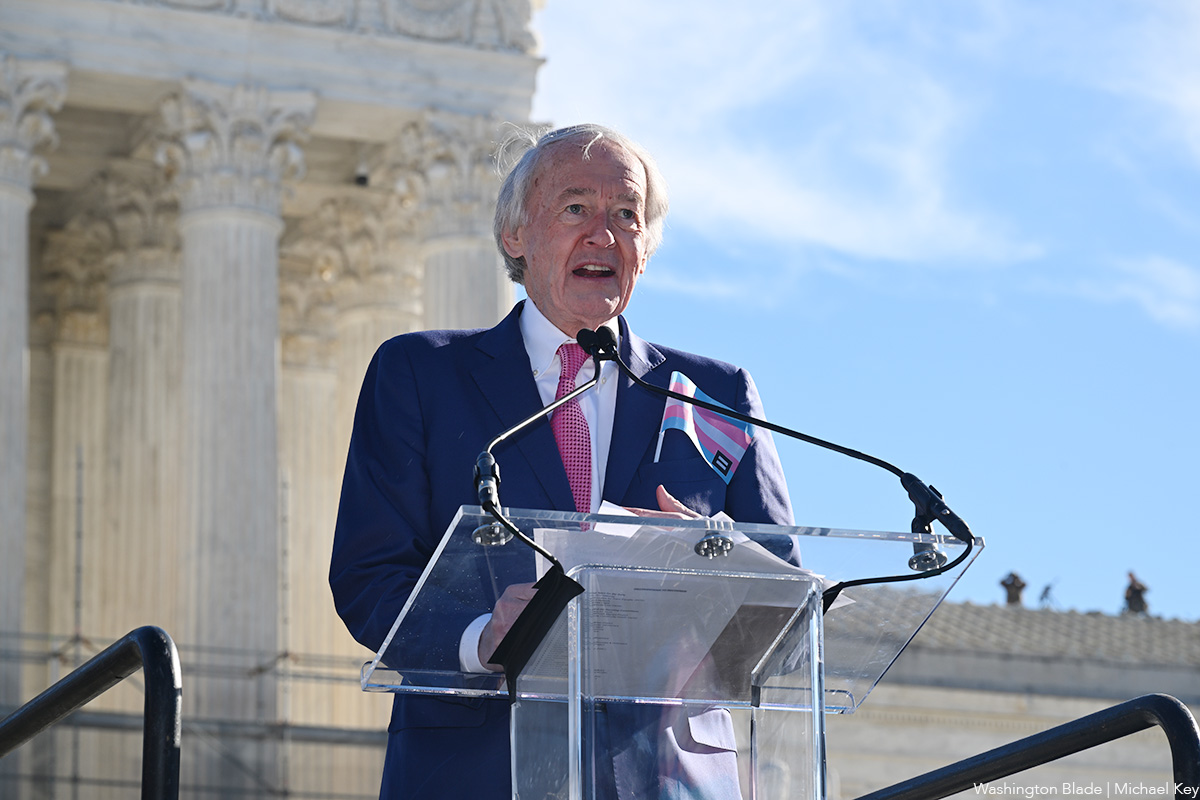
U.S. Sen. Ed Markey (D-Mass.) clinched the Democratic seat for his reelection campaign in Massachusetts’s primary election on Tuesday.
Markey won the deep-blue state with 64.8 percent of the vote, according to NBC News, triumphing over Marine Corps combat veteran and Congressman Seth Moulton, who received 35.2 percent of the vote.
Massachusetts’s primary election, which determined which Democratic candidate will head to the polls to face off against the Republican challenger in November, is being considered a victory for LGBTQ+-inclusive policy, as well as for a divisive pro-transgender rights candidate — both things Markey has become an outspoken champion of.
Markey has experience at multiple levels of government, from the state level, where he served three terms in the state House of Representatives, to his federal tenure, including 20 terms in the U.S. House of Representatives and is now serving his second term as a senator. He has become a fixture of a changing Democratic Party in one of the most consistently blue places in the U.S.
This primary — and much of the national discussion surrounding the Senate seat — focused a lot of campaigning power on fighting the growing sentiment, led mostly by Republicans, that the frustration many Americans feel lends itself to an anti-establishment and anti-incumbent attitude.
Markey ran his campaign using his past as a reflection of his commitment to constantly putting his best foot forward for Bay Staters — particularly with apprehension for issues younger and more progressive democrats have been righting for — including Green New Deal and “Medicare for All” while Moulton — who was also elected to federal office prior to this run — campaigned on being younger than Markey, arguing that he was not the same type of established politician.
Moulton also faced backlash for negative comments about trans athletes, sparking criticism for those who did want younger candidate but want for trans rights to be protected.
Markey’s track record of supporting the LGBTQ+ community is one of the most clear in federal politics, one that has garnered a “100 percent lifetime voting record” on the Human Rights Campaign’s PAC politician review scorecard.
That list of Markey’s actions includes being a cosponsor of the Equality Act, driving landmark legislation to ensure federal protections for LGBTQ+ Americans, and being one of the most vocal proponents for trans rights in the federal government — specifically in multiple appropriations bills and in the National Defense Authorization Act. He was also the lead sponsor of the Transgender Health Care Access Act and the Transgender Bill of Rights resolution.
Markey first introduced the Transgender Bill of Rights in the Senate in 2023, where it ultimately failed to be brought to law. He reintroduced the legislation this year once again. This was a direct response to the attitude pushed by many conservatives after 2021, when the push to minimize trans rights started to become a key part of their cause and has been constantly propped up by the Trump-Vance administration.
“Massachusetts needs a senator who stands up and fights back, a senator who never forgets who they are fighting for,” Markey said during his victory speech. “That has been the mission of my life, and it always will be.”
Following the calling of the primary, a slew of LGBTQ+ organizations rallied behind Markey, many pushing his past as an asset that puts his money where his mouth is through advocating for legislation specifically protecting the LGBTQ+ community.
Tyler Hack, the executive director of the Christopher Street Project, an organization dedicated to pushing for legal protections for trans americans, released a statement following Markey’s win. Hack argued that putting forward such a staunchly pro-trans candidate is a win for the community, especially after endorsing him earlier this year.
“Tonight, anti-trans politics lost. Massachusetts rejected the idea that attacking transgender people is a shortcut to political power. Voters chose a different path: one where equality is not negotiable, cruelty is not courage, and transgender people do not have to disappear for Democrats to succeed.”
The Human Rights Campaign also endorsed him as a candidate earlier this year and issued a statement via its president, Kelley Robinson.
“Ed Markey has spent decades fighting for LGBTQ+ equality, for working people, and for a more livable world,” Robinson said. “He knows why equality matters. He’s stood with us no matter what. We were proud to endorse him this year, and when a pro-equality majority takes back the Senate this fall, we will continue to count on him as a champion for our community.”
Markey is running for reelection against Republican John Deaton in November, where he is expected to win.
Politics
Out combat vet Cait Conley fights Trump flunkie for New York’s flippable 17th Congressional District
Conley on GOP’s big money: “Outspent. Not Outfought.”

Consider the timing. Two weeks before the 25th anniversary of the Sept. 11, 2001, terrorist attacks and two months before the midterm elections, top U.S. military leaders alert the public that Donald Trump and Defense Sec. Pete Hegseth’s bellicose incompetence is dangerously weakening national security.
On Sunday, Aug. 30, The Washington Post reported that the heads of the Army, Navy and Air Force and the four-star commanders overseeing U.S. operations throughout Europe, Asia and Latin America warned Hegseth directly that “prolonging large-scale operations against Iran is unsustainable and risks weakening their ability to confront threats elsewhere, including the U.S. homeland, according to people familiar with a recent assessment prepared for the Pentagon chief.”
Pentagon spokesperson Sean Parnell responded on X, trying to discredit the reporting without disputing Hegseth’s plan to keep more than 50,000 U.S. troops in the Middle East through September, with some deployments possibly extended into 2027.
“Publishing highly classified assessments from the Secretary’s orders book is a crime,” he wrote. “We are in great shape around the world. This story isn’t about readiness. It’s TDS and PDS – they hate President Trump and Secretary Hegseth more than they love America.”
On Monday, Army Sec. Dan Driscoll resigned “amid reports of heightened discord with Secretary of Defense Pete Hegseth,” Military Times has learned, adding that “the Army is effectively leaderless. Hegseth fired Army Chief of Staff Gen. Randy George in April and has yet to nominate a replacement for the Army’s top uniformed post.”
The Post notably experienced government pushback 55 years ago when the Nixon administration tried but failed to stop or criminalize publication of the Pentagon Papers, the leaked “top secret” report on U.S. policymaking in Vietnam showing that two presidents promised victory while knowingly sending thousands of soldiers to fight an unwinnable war.
In 1971, the Supreme Court ruled against President Richard Nixon’s claim of executive authority, with Justice Hugo Black writing, “The press was to serve the governed, not the governors.” This Trump-loving Supreme Court, however, granted the convicted felon president broad immunity for official acts, which Trump has exploited with the complicity of a feckless Republican majority in Congress.
On Sunday, after a month’s respite in the six-month failed war against Iran, the U.S. military struck Iranian rocket launchers on the Strait of Hormuz that a U.S. Central Command spokesperson told the Associated Press were prepared to replace cleared sea mines in the international shipping routes. Iran retaliated for the “deadly attack.”
Five-time draft dodger Donald Trump may be “bored” with the war he started, but the rest of the world is scrambling. Treasury Secretary Scott Bessent is meeting with world finance ministers faced with aggressive tariffs on major allies. And then there’s the $40 trillion debt.

This is the “everything-all-at-once” existential crisis in which Americans must consider candidates for the Nov. 3 midterms. After the deep DOGE cuts of national and cybersecurity experts, conscientious voters should consider candidates with trustworthy, reality-based experience. Unfortunately, polls and donations are still considered the key barometers for victory.

Axios, for instance, recently reported that House Democrats are quietly helping Republican Rep. Mike Lawler’s re-election campaign against combat vet and national security expert Cait Conley by not fighting hard enough in New York’s 17th Congressional District, considered the most vulnerable House seat in the country.
The battleground seat in the Lower Hudson Valley area could decide which party controls the House next year. But it took the Democratic Congressional Campaign Committee more than two weeks after Conley dusted her four opponents in the June primary, winning 51.4 percent of the vote, to include her in its “coveted” Red-to-Blue program.
The designation is “signaling that the DCCC is invested in providing Conley, a top-tier candidate, with the support needed to continue building a winning campaign as she runs for New York’s 17th Congressional District,” according to the committee.
The University of Virginia’s Center for Politics and the Cook Political Report subsequently shifted the race from “Leans Republican” to “Toss-up.”
However, the “Lawler campaign has a commanding advantage in available funds and booked media,” which includes “millions” from Elon Musk, according to the Conley campaign. Trump, Cabinet secretaries, and House leaders like House Majority Leader Steve Scalise (R-La.) have campaigned for Lawler.
Democrats still seem soft. “If you’re going to have a Republican, it’s the kind of Republican we want in the Congress,” a Democratic source told Axios of Lawler.
“I don’t think Lawler is beatable,” a senior House Democrat told Axios.
When asked by The Hudson Independent about the money disparity, “The response by West Point graduate Conley: ‘Outspent. Not Outfought.’”
Conley says she lives by the Special Ops saying, “run to the sound of the guns.” But Lawler and his Republican friends think calling her “scaredy-cat” for “chickening out” by not meeting his challenge to debate on CNN or NBC makes him look strong.

Both are 39 years old, so consider how their life experiences may fit today’s needs.
Conley, a fourth-generation Hudson Valley native from a working-class family, was a junior at Pine Bush High School when the Twin Towers fell on 9/11. The next day, she began her application to West Point, where she graduated in the top 2% of her class. She later received advanced degrees from MIT and Harvard, accruing expertise in national security.

Conley served for more than 16 years as an active-duty Army officer, deploying six times to combat zones, including Iraq and Afghanistan, where she became one of the first women to serve in Special Operations leadership. She received three Bronze Stars and a stellar reputation for exceptional leadership under pressure.
Conley subsequently served as director for counterterrorism on the National Security Council at the White House. She transferred to the Cybersecurity and Infrastructure Security Agency, where she helped safeguard critical infrastructure and election systems – always defending the integrity of the people and American democracy.
Lawler never served in the military nor worked to protect national security. According to his campaign website, he grew up in Rockland County, graduated from Suffern High School, and was valedictorian at Manhattan College in the Bronx, where he majored in finance and accounting.
Lawler served as deputy town supervisor of Orangetown, senior advisor to the Westchester County Executive, and executive director of the New York State Republican Party, and he founded a successful government affairs and public relations firm. He was then elected to the New York State Assembly. He touts his 2022 Congressional victory over the gay chair of the Democratic Congressional Campaign Committee.
In 2024, Lawler won a congressional district that Democratic presidential candidate Kamala Harris won. “In that race,” his website says, “he outperformed the presidential ballot by nearly 7 points, a testament to his bipartisan, pragmatic approach to governing and his broad appeal among Democrats and Independents.”
Lawler has voted five separate times to back Trump’s Iran war, about which, he told News Nation, he had privately been given information about an “imminent” nuclear threat. Six months later, he believes the war is “absolutely worth it,” though gas prices are above $4.15 per gallon.
Conley has an impressive list of endorsements – most of whom are local. So VoteVets launched a $1 million dollar ad buy for Conley, highlighting Lawler’s record of voting with Trump “100% of the time.”
The VoteVets ad, “Valley Home,” highlights Conley’s roots, her working-family background, her commitment to serve after the 9/11 terrorist attacks, and her military leadership.
In an interview with Trudy Ring for LGBTQ+ Freedom Fighters, Conley likened her decision to challenge Lawler to her decision to join the military.
“The reason I’m in this fight to take back New York 17, flip it from red to blue, and get Mike Lawler out of here, and is the same reason that over 20 years ago I decided to serve this country after the terror attacks of 9/11,” she said. “It is love for this country and a feeling of responsibility to our community in this country to fight for it.”
“Washington has grown increasingly corrupt, especially under this administration, which has just set a whole new bar for a willingness to exploit the federal government for personal gain, to use the federal government as a weapon against political opposition, and the level of corruption that we are seeing from the White House and [Donald] Trump himself, his family making $2 billion while he’s in office, right?” she added.
“The shamelessness—it’s straight up un-American, and it has been enabled by cowards in Congress like Mike Lawler, and so we have to stop it, and that’s what this fight’s about. No one else is going to come in and save us. This is our fight, and that’s why I’m proud to take it on,” Conley said.

Lawler touts himself as a moderate, but he “has voted 100 percent of the time with Donald Trump,” Conley said. “What does that mean? Well, it means voting eight times for reckless tariffs that have jacked up the price of goods on everything from prescriptions to groceries in the middle of an affordability crisis. It has cost an average household $4,200 for the same goods because of these tariffs.”
“There is no line Mike Lawler will not cross for Donald Trump. When Donald Trump says jump, Mike Lawler’s response is ‘how high?’ People here in the Hudson Valley deserve a hell of a lot better.”

If elected, Conley’s priorities will include lowering costs of health care and other necessities, investing in education, addressing climate change by promoting clean energy, codifying reproductive rights, reforming the immigration system and reining in Immigration and Customs Enforcement (ICE), fighting cuts to Medicare, Medicaid, and Social Security, championing LGBTQ+ rights, and generally combating the policies of the Trump administration.
Caring about the military is also a priority.
Pete Hegseth is incompetent and should never have been confirmed as Secretary of Defense, Conley said. He’s depriving the military of talent by kicking out transgender service members, women, people of color, and those who simply disagree with him. Trans military members, she noted, “are men and women who have more courage in their big toe than Donald Trump and Pete Hegseth have combined.”
She has also decried the mistreatment of troops such as those who’ve been at sea on the USS Lincoln for nearly nine months, facing food shortages and generally horrific conditions that have led to mental health crises.
Asked about Trump’s recent decision to reduce joint military exercises with South Korea and to meet with North Korean dictator Kim Jong Un, Conley said, “I’m at a loss of words sometimes. … We should be standing by our allies like South Korea. We should be standing by our allies like NATO and Europe. We should be standing by our allies like Ukraine. But instead, because our president has this bizarre affinity for dictators,” he prefers countries that are our “strategic adversaries,” like North Korea and Russia.
Conley’s been called a war hero, but she doesn’t refer to herself that way.

“What I would say is I’ve proudly served,” she said, noting the personal sacrifice of serving in silence as a lesbian under “Don’t Ask, Don’t Tell.”
“You saw brave service members who are willing to make the ultimate sacrifice for this country but had to live in fear,” she said. “That’s not America.”
Later, as director for counterterrorism on the National Security Council (NSC), she got banned from Russia, along with such big names as former President Obama and comedian Stephen Colbert, something of which she’s proud. Since the list was alphabetical in English, as a “huge fan,” Conley said it was “one of the coolest things” seeing her name listed after Colbert’s.

Immigration reform is another priority. “It has broken my heart, as someone who loves this country, to watch, on American streets, American federal agents … literally killing the very people they’re sworn to serve and protect, and there’s no accountability. That’s not a partisan issue. That’s a straight American issue.”
Conley’s district has the second-highest number of Haitian immigrants in the U.S., and Trump recently revoked their Temporary Protected Status (TPS), a status that meant they were legally cleared to work and wouldn’t be deported. Since many work in health care, deporting them would hurt the immigrants and the communities they serve. This is another example of the “cruelty and corruption” of the Trump administration, Conley said.
She also noted that 37,000 people in her district will lose health insurance due to Medicaid cuts and the revocation of certain tax credits for premiums on Affordable Care Act plans. She favors a public option for health insurance.

“I talk to families all across this district, and what I hear is people, regardless of political affiliation, are sick of the dysfunction and partisanship that is tearing communities and families apart, and they want to get back to doing what is right for our future and focusing on solving the very real problems,” Conley said.
If Conley is elected, it would be sweet revenge for the LGBTQ+ community; Lawler has previously beaten two gay candidates, five-term Congressman Sean Patrick Maloney and former Congressman Mondaire Jones.

“Third time’s the charm, and let me tell you, he has never had to face someone like me before,” Conley said. “Yes, absolutely a proud member of the LGBTQ community, but also a woman veteran… It’s about our future, and so folks are coming together. There’s a generation of us that are hungry to get in there and root out the corruption that I feel like has taken root in Washington, to root it out and to really deliver.”
This article is cross-posted from Karen Ocamb’s Substack LGBTQ+ Freedom Fighters.
Congress
HRC president campaigns for Chris Pappas in NH
Gay congressman running to succeed retiring U.S. Sen. Jeanne Shaheen
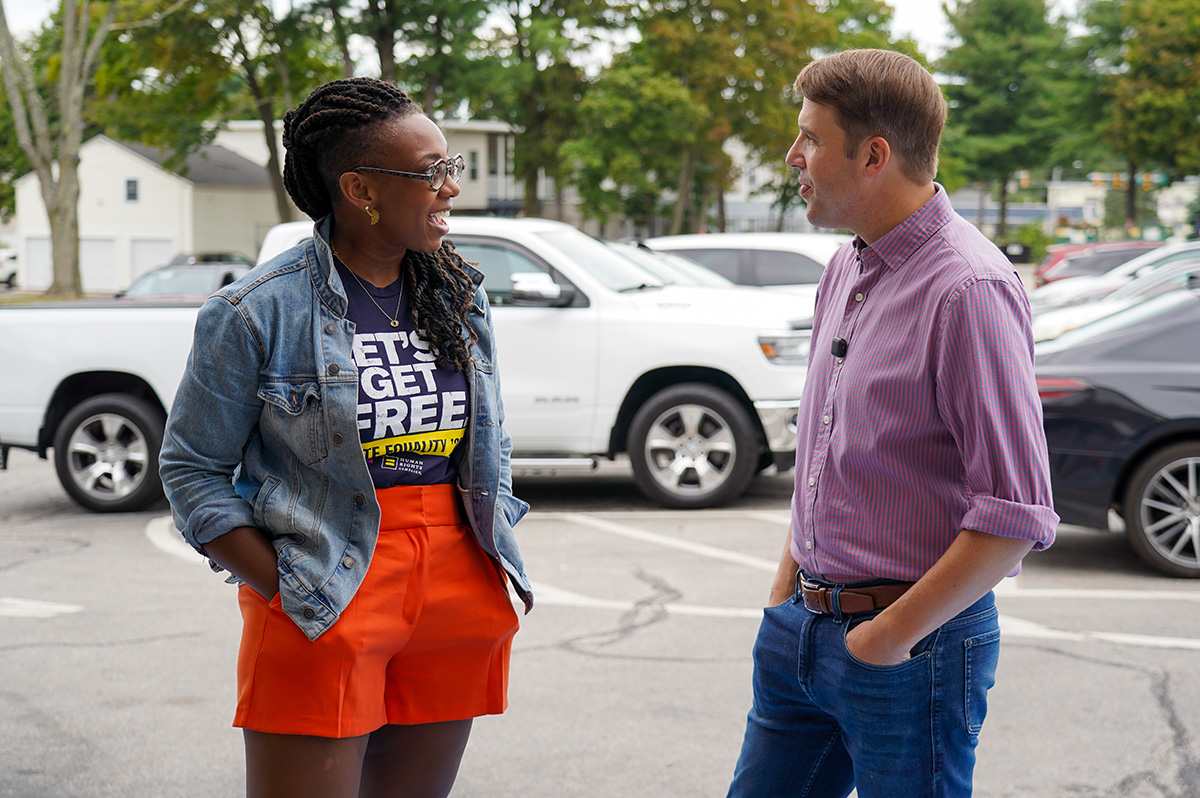
Human Rights Campaign President Kelley Robinson on Sunday campaigned for U.S. Rep. Chris Pappas (D-N.H.) in New Hampshire.
Robinson traveled to Manchester, the state’s largest city, nine days before the Sept. 8 primary that will determine who will vie for retiring U.S. Sen. Jeanne Shaheen (D-N.H.)’s seat.
We’re hitting the pavement across New Hampshire to fight for a freer, fairer future for everyone.
Glad to have Human Rights Campaign President @KelleyJRobinson join us for a canvass launch in Manchester today. pic.twitter.com/XWCEaQxy4o
— Chris Pappas (@ChrisPappasNH) August 30, 2026
Former U.S. Sen. John E. Sununu, who represented New Hampshire in the U.S. Senate from 2003-2009, will face off against former U.S. Sen. Scott Brown, who represented Massachusetts in the U.S. Senate from 2010-2013, in the Republican primary.
Karishma Manzur is among the Democrats challenging Pappas.
A poll the University of New Hampshire Survey Center released on Aug. 26 shows Sununu is ahead of Brown. The same survey shows Pappas ahead of Manzur and his other Democratic challengers.
The UNH Survey Center poll shows Sununu ahead of Pappas by a 45-43 percent margin if they were to face off in the general election. The margin of error is +/-2.1 percent.
Pappas would become the first openly gay man elected to the U.S. Senate if he were to win in November.
Politics
From the desk of Equality California: End of August top political news for California’s LGBTQ
Equality California is busy
as ever, continuing to endorse pro-equality
candidates up and down the ballot, and working to move our priority legislation
through final votes and to the governor’s desk.

From the Desk of Equality California:
As we hurdle toward the November midterm elections, Equality California is busy as ever preparing for our fall events season, continuing to endorse pro-equality candidates up and down the ballot, and working to move our priority legislation through final votes and to the governor’s desk.
We’re also accepting applications for our final Leadership Academy of the year. This special Gender Equity Edition will help prepare lesbian, bisexual and queer women, as well as transgender and nonbinary people, to run for office and serve their communities.If you’re interested in applying or know someone who’d be a great fit, learn more!
To read more stories, join our mailing list, and sign up for the weekly Equality Brief, visit eqca.org/equalitybrief.
- Trump Administration Denies Trevor Project Proposal to Run ‘Press 3’ Crisis Line:
As the Department of Health and Human Services prepares to reinstate specialized crisis services for LGBTQ+ youth at the national 988 Crisis Line, they have formally denied a proposal from the Trevor Project — who helped initially create and launch the service — to help with administration. The toll-free 988 Lifeline’s “press 3” hotline, which provides confidential assistance by trained counselors, originally launched in 2022. - Survey: 12% of Adult U.S. Population Identifies as LGBTQ+:
A recent analysis of data collected from the U.S. Census Bureau’s Household Plus Survey between 2021-24 shows that 12%, or nearly 26.5 million adults, identify as part of the LGBTQ+ community. This was the last effort by the federal government to collect information on sexual orientation and gender identity before the Trump administration removed such questions on hundreds of federal surveys. The majority of the respondents — 53% — fall between ages 18-34. - Trump Administration Finalizes Discriminatory Rule Targeting Transgender Healthcare:
The Trump administration finalized a cruel and discriminatory rule blocking federal Medicaid and CHIP payments to providers for medically necessary healthcare for transgender young people, putting access to care at risk — particularly for young people from low-income families. The rule is scheduled to take effect October 13, but it does not make transgender healthcare illegal in California or prevent the state from using its own funding to cover care. Equality California and our partners secured a historic $26 million investment in the state budget to protect access to care and stabilize California’s transgender healthcare provider network. - Pentagon Uses Secretive Separation Boards to Expel Transgender Servicemembers:
A New York Times investigation revealed how the Pentagon is using closed-door separation boards to remove transgender servicemembers from the military, often regardless of their records of exemplary service. The proceedings have no cameras or public transcripts, and some servicemembers have been barred from their own hearings after refusing to cut their hair or wear uniforms corresponding with their sex assigned at birth. One attorney who has represented dozens of transgender troops reported losing 27 of 28 cases before the boards. - Trump Justice Department Violates Federal Order; Judge Considering Sanctions:
In just the latest flouting of a legal ruling, the Trump Justice Department violated U.S. District Judge Royce C. Lamberth’s order preventing transgender women in federal custody from being moved into segregated housing. Issued in May, Lamberth’s order arose from a case challenging the constitutionality of a Trump executive order requiring federal inmates be housed on the basis of their sex at birth. The legal challenge is still active, with Lamberth ruling earlier this year the case could proceed as a class-action lawsuit. When questioned by Judge Lamberth, Justice Department attorneys claimed they were in compliance while plaintiffs’ attorneys argue the spirit of the order was clearly violated. Lamberth is now considering potential sanctions, as well as how best to ensure enforcement of his order. - House Passes 2027 NDAA With Anti-LGBTQ+ Amendments, Anti-Trans Military Effort Defeated:
By a vote of 216-212, the House passed the 2027 National Defense Authorization Act (NDAA), an annual Defense Department appropriations bill, with two anti-LGBTQ+ provisions attached. The first provision prohibits funding for transition-related healthcare for active-duty troops, while the second targets healthcare for transgender servicemembers and their dependent children under TRICARE, the military’s primary health provider system. One particularly ugly amendment offered by anti-LGBTQ+ extremist Rep. Lauren Boebert (R-CO) sought to codify a Trump executive order — currently undergoing a legal challenge — barring transgender people from enlisting in the military and discharging active-duty transgeneder servicemembers, but was defeated. The bill now moves to the Senate, where passage is not guaranteed. - Federal Employees and Their Families Sue Trump Administration Over Transgender Healthcare Exclusion:
Federal employees and their families have joined a class-action lawsuit challenging the Trump administration’s decision to exclude medically necessary transgender healthcare from federal employee health plans. The lawsuit argues that the blanket exclusion, which applies to people of all ages, violates federal protections against sex discrimination. According to the Williams Institute, at least 39,400 people enrolled in federal health plans are affected by the policy.
STATE LEGISLATIVE UPDATE
Equality California’s priority sponsored legislation continues to move through the legislative process. A handful of our bills have been transmitted to the governor’s desk, while others await final action in the legislature. To view our entire 2026 state legislative package, visit eqca.org/legislation
2026 SAFE AND SUPPORTIVE SCHOOLS REPORT CARD
Earlier this month, Equality California Institute released the fourth iteration of the Safe and Supportive Schools Report Card. The survey measures how well California’s Unified School Districts adhere to state education law around inclusive curriculum and anti-bullying policies, as well as their overall support for LGBTQ+ students. While there were some highlights, overall the data presented more challenges and opportunities as opposed to outright successes. Read the full Report Card on our Schools hub.
UPCOMING EVENTS
Our premier event of the year, the Los Angeles Equality Awards, is happening on Saturday, October 17, 2026 from 6:00-10:00 PM at the gorgeous Fairmont Century Plaza. And this year, we’re making Monét moves — Drag Race All-Stars winner, comedian, actor, and presenter Monét X Change will serve as emcee! We’ll also honor Asm. Rick Chavez Zbur with the Equality Leadership Award. More details will be announced soon, but tickets are on sale now! Don’t miss out!
Politics
Log Cabin Republicans remove transgender rights from mission
Decision made after ‘significant discussion’ with members, board

Log Cabin Republicans, an organization that formerly represented LGBTQ+ conservatives, has removed advocating for transgender and queer rights from its “renewed” national advocacy focus.
In an opinion piece written by Log Cabin Republicans President Ross Hemminger for the conservative media outlet Town Hall, he announced that trans rights would no longer be part of what the organization advocates for through conservative leadership and candidates.
In his piece, Hemminger wrote that after “significant discussion” with members and Log Cabin Republicans’ board of directors, the organization’s leadership voted to “refine Log Cabin Republicans’ national advocacy focus to concentrate specifically on issues of sexual orientation and conservative values,” a focus that does not include trans people.
“We have fought for the right to legally marry who we love, serve our country and our communities openly and proudly, and to enjoy the same inalienable rights afforded to all law-abiding Americans — and we succeeded,” Hemminger wrote. “However, the new era of gender identity politics is not the movement we supported and fought for. Gay men and women are losing public support across the country, and support for gay marriage and other once-widely accepted rights is eroding. Why? Because many voters today weren’t alive or cognizant of the politics of gay marriage winding its way through the courts and gaining ground in public opinion. Their view of the gay community is based on today’s radical transgender activists with their unnecessary and discomfiting focus on America’s youth.”
Hemminger then went on to argue that trans advocacy has shifted to focusing primarily on minors — a characterization that does not reflect the breadth of issues trans advocates address.
“They push schools to teach radical gender ideology; they want biological men in women’s sports regardless of the consequences; perhaps most offensively, they support gender reassignment treatments for minors, often without the knowledge or consent of the parents, knowing full well these treatments are mostly irreversible,” he wrote.
Hemminger and many right-wing political leaders have continued to assert this false reality as fact.
A Harvard-affiliated study found approximately 2.1 gender-affirming surgeries occur per 100,000 trans and gender-diverse minors diagnosed with gender dysphoria, underscoring how uncommon these procedures are among minors. In addition to the option of surgery for those who think it’s right for them, there is an array of other medically sound options to treat gender dysphoria, which according to KFF, an independent source for health policy research and polling, includes “medical, surgical, mental health, and non-medical services for transgender and nonbinary people.”
Additionally trans advocacy is not as narrow as Hemminger makes it seem in his opinion piece.
There are a slew of issues the trans community faces — and fights for — on a daily basis that have nothing to do with healthcare. Those include obtaining government documents that accurately reflect one’s gender identity, multiple elements of family law that include the right to marry and adopt children as straight couples can, protections from violence, hate crime protections, the right to serve in the military, access to bathrooms corresponding with their gender, and the right to education.
Despite the overwhelming number of issues trans people — regardless of political affiliation — have to struggle with as a result of systemic gaps in protections that are supposed to be afforded to everyone under the law, they remain vulnerable to unequal treatment.
Despite this shift, Log Cabin Republicans has committed to standing with the Republican Party rather than LGBTQ+ people as a whole. The organization was initially founded as a loosely connected network of local California social clubs made up of LGBTQ+ conservatives in the late 1970s before eventually emerging as a national political organization in the early 1990s under its founding executive director, Rich Tafel.
As the organization continued to gain momentum, it endorsed a handful of Republicans who voted against the Respect for Marriage Act, the 2022 law that federally recognized marriage equality for same-sex couples.
The Los Angeles Blade reached out to Log Cabin Republicans for comment but did not hear back by the time of publication.
White House
Trump-Vance administration’s LGBTQ+ brain drain: what you need to know
Several high profile figures have left government since January 2025

Uncloseted Media published this article on Aug. 21.
By SPENCER MACNAUGHTON and HOPE PISONI | Since President Donald Trump regained office in January 2025, he and his administration have waged an all-out war against the LGBTQ+ community.
This has led queer Americans to move to other countries at unprecedented rates — Rainbow Railroad, a Canadian nonprofit that supports LGBTQ+ asylum seekers, reported receiving a huge increase in inquiries from the U.S. last year.
The same pattern is playing out within the government. And it’s leading to a brain drain of competent queer employees and allies who are either resigning or being fired, often because of their LGBTQ+ identity or their belief that queer people deserve basic human rights.
Here are six examples of federal workers who had a messy exit from Trump 2.0:
Demetre Daskalakis
- WHAT HE DID: Dr. Daskalakis is one of the foremost LGBTQ+ health professionals in the U.S. Under Trump’s first term, he was appointed director of the Division of HIV/AIDS Prevention at the Centers for Disease Control and Prevention. Under Biden, he also served as the deputy response coordinator for mpox at the White House.
- WHAT HAPPENED: While he continued a lot of this work under Trump 2.0, he didn’t last long. In August 2025, he resigned from the CDC, writing in his resignation letter that he was “unable to serve in an environment that treats CDC as a tool to generate policies and materials that do not reflect scientific reality and are designed to hurt rather than to improve the public’s health.”
- BOTTOM LINE: I recently interviewed Daskalakis, where he told me that leadership from RFK Jr.’s Health and Human Services Department justified HIV cuts by saying the virus is “just too woke.”
Julia Curlee
- WHAT SHE DID: Julia Curlee worked in intelligence for nearly two decades between the CIA and the National Security Council. Earlier this week, she wrote an article in The Atlantic explaining how she had served as Mike Pence’s daily briefer and the NSC’s director for intelligence programs. During Trump 1.0, she briefed the president on Air Force One.
- WHAT HAPPENED: Curlee told CNN this week that in Trump’s second term, her treatment by the federal government transformed. She was no longer allowed to use the women’s bathroom on federal property and had to leave her workplace to relieve herself. Her passport was also reissued to read “male,” which led to complications when traveling abroad. In March 2025, less than 70 days into Trump’s second term, Curlee says she received a call while at a rib joint in Virginia with her family informing her that her White House tour was over and that they couldn’t tell her why. She continued to work for the CIA for some months, but she later resigned.
- BOTTOM LINE: Curlee wrote that moments after she learned she was fired from the White House, she saw a post from right-wing political activist Laura Loomer that read “A transgender, Biden holdover who hates President Trump is still working in the NSC intel office. I’m told there are several NSC staffers who have complained that this trans Biden holdover hasn’t been fired yet, but nothing is being done about it.”
Marc Seawright
- WHAT HE DID: Marc Seawright worked for more than eight years at the U.S. Equal Employment Opportunity Commission. Most recently, he served as the EEOC’s director of information governance and strategy, where he oversaw tech policy to help combat workplace harassment and discrimination.
- WHAT HAPPENED: During Trump 2.0, Seawright was ordered to develop technology that would erase any mention of LGBTQ identities from EEOC outreach materials. “[My expertise] was being leveraged to perpetuate discrimination against people like me,” he told the Associated Press. In that article, Seawright and other transgender and gender nonconforming federal employees described their “fear, grief, frustration, and distress working for the federal government at a time when it rejects them — often with no clear path for recourse or support.”
- BOTTOM LINE: Seawright quit in June, citing a hostile work environment. “It became overwhelming. It felt insurmountable,” he told the AP. He has now hired lawyers at Katz Banks Kumin and has filed a discrimination complaint.
David Maltinsky
- WHAT HE DID: Until 2025, Maltinsky worked for more than 16 years at the FBI as an intelligence specialist. In 2025, he was training to become a special agent, but three weeks ahead of graduation, he was fired.
- WHAT HAPPENED: On Oct. 1, he was delivered a letter from FBI Director Kash Patel informing him that he was being fired for an “inappropriate display of political signage.” The signage in question, according to Maltinsky, was a Pride flag displayed in his work station at a previous post in Los Angeles. The flag had been given to him by the FBI’s LA Field Office, and Maltinsky says he had been told by multiple supervisors that displaying it would not be a violation.
- BOTTOM LINE: Maltinsky is currently suing the FBI and the Department of Justice, arguing that his firing constituted unlawful discrimination.
Mary Brinkmeyer
- WHAT SHE DID: Brinkmeyer had been working as a psychologist for the Department of Veterans Affairs since 2008. She held multiple leadership roles, including the LGBTQ+ veteran care coordinator at the Hampton VA Medical Center. She established the first military support group for trans servicemembers and was awarded Navy Psychology Civilian Psychologist of the Year in 2016.
- WHAT HAPPENED: Following an early Trump executive order directing the federal government to purge any practices promoting “gender ideology,” Brinkmeyer says staff at her workplace were told to remove all LGBTQ+-affirming materials from both public and private areas, as well as to identify “anything in medical records, training materials, or patient resources that could be considered ‘gender ideology.’” When she refused to comply and confronted her supervisor, she says her concerns were dismissed.
- BOTTOM LINE: Brinkmeyer resigned in February 2025, stating that she “didn’t want to be complicit in something that I knew was wrong.”
Amy Paris
- WHAT SHE DID: Paris was the second-highest ranking trans woman in the federal government, serving as a deputy digital services lead in the HHS Department, where she oversaw the safety of organ donations. Prior to that, she worked in a number of tech-related roles across the federal government since the Bush administration. She helped create cross-agency spending trackers, streamlined unemployment insurance during the pandemic and implemented trans-inclusive policies like gender-neutral passports.
- WHAT HAPPENED: Paris was fired as part of a string of mass layoffs across the federal government in February 2025. While the HHS did not publicly comment on why she was fired, Paris says she was told it was because of her performance, despite the fact that she got a 4.75 out of five on her last performance review and was praised for her work by multiple Biden administration officials.
- BOTTOM LINE: Paris told the 19th she suspected her firing was politically motivated, saying the Trump administration is “trying to sow discord and disrupt confidence in the workings of the federal government.”
Politics
Summer Democratic Primaries keep popping up surprises
“Floridians are worried about the cost of housing, healthcare, food, and gas — not the color of their sidewalks or the governor’s opinion on their personal life.” – Democratic candidate David Jolly

Tuesday’s primary races in Florida, Alaska, California, and Wyoming saw a mix of establishment versus insurgent on the Democratic side and right versus far right among Republicans, suggesting that the power of lame duck Donald Trump’s endorsement is apparently waning.
In Republican primaries in Wyoming and two congressional districts in Florida, only 28% of the nearly 300,000 voters followed Trump’s orders, “marking a particularly brutal night for Trump-endorsed candidates,” CNN reported.
That brings to 10 the number of Trump-backed candidate losses for statewide office or Congress this primary season, “equal to the number who lost in 2018, 2020 and 2024 primaries combined, according to a CNN analysis using Trump endorsements compiled by Ballotpedia.”
Ironically, Tuesday night also saw development in a primary of deep interest: Trump-appointed Sen. Darline Graham, sister of the late rumored-to-be-closeted Republican Sen. Lindsey Graham, face-planted in a debate against primary runoff opponent, Rep. Ralph Northam, before next Tuesday, Aug. 25’s special runoff election in South Carolina.
Conservative debate moderator Greta Van Susteren asked the candidates about Taiwan, a democratic island of 23 million people that the Chinese Communist Party intends to “unify” with China. “Are Taiwan and the South China Sea national security issues for the United States? If so, why?”
“I’m not … that informed on national security, so — but I do support the military,” Graham said. “National security is not my thing, not my area of expertise, but I do support the military.”
Northam said that “Taiwan’s a definite ally,” but, CNN reported, he applauded Trump for “enabling Taiwan to defend itself against China.”
Trump’s response to Tuesday night’s primaries was to take the press corps on an impromptu tour of the new White House driveway, paved with California-mined white granite described as a “very special stone” that leads effortlessly to the now almost $900 million ballroom – which he describes as “the military complex” – where construction continues despite a court order to stop. The tour also included the newly flat helipad on the South Lawn.
Meanwhile, pundits are filling up cable and internet airtime asking, “Who, exactly, is Natalie Harp to Donald Trump?” The New York Times featured an extensive consideration of Trump’s 35-year-old blonde constant companion dubbed his “human printer.”
But for those focused on gas prices, affordability, the war in Iran, and polls showing Trump’s historic disapproval ratings and the disaffection of MAGA voters, dissecting political trends in the face of fast-approaching midterms is like analyzing code showing a growing tsunami on a funky old laptop.
LGBTQ+ Floridians hoped voters would send a Black gay man to the U.S. House. Three were on the ballot – Shevrin Jones, Kendrick Meek Jr., and Elijah Manley – but the congressional hopefuls were each defeated.
Jones, a Florida state senator, lost narrowly to Oliver Gilbert III, a Miami-Dade County commissioner, in the race for the Democratic nomination in the 24th Congressional District. Rep. Frederica Wilson, retiring after eight terms, endorsed Gilbert as her successor. Jones secured 32 percent of the vote to Gilbert’s 34 percent in a field of seven candidates that included Meek, son and grandson of former U.S. representatives, who finished with 17 percent.
Te Mayonna Brown, who touts “traditional values” on her campaign website, was unopposed for the Republican nomination. But since the South Florida district is one of the few still safely Democratic after Republican-led redistricting, Gilbert is expected to win in November.
Jones congratulated Gilbert and pledged support. “Looking ahead to November, I’m committed to doing everything I can to help elect Democrats up and down the ticket. The stakes are too high to sit on the sidelines, and I’ll be out there campaigning and organizing for our candidates because our shared values are worth fighting for, in this race and every one that follows,” he said in a statement.
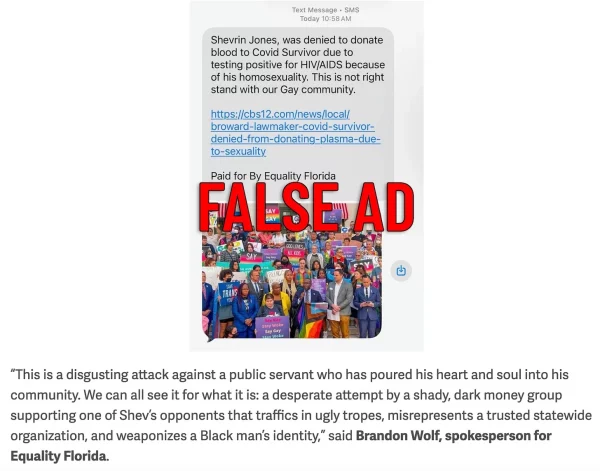
Jones was hit with a homophobic attack during the campaign. A text message, falsely claiming to be from the LGBTQ+ rights group Equality Florida, falsely claimed that Jones is HIV-positive and was turned away from donating blood, despite the lifting of the national ban on blood donations by gay and bisexual men three years ago.
In the Democratic primary for Florida’s 20th Congressional District, Debbie Wasserman Schultz, a longtime congresswoman and LGBTQ+ ally, defeated Manley and three others. Wasserman Schultz currently lives in and represents the 25th District. But Republican redistricting put her in the 22nd District, which is Republican-leaning. So Wasserman Schultz, who is white, decided to run in the heavily Democratic, majority-Black 20th District in South Florida, which has been represented by a Black Democrat for more than three decades.
Though Wasserman Schultz had allies, Politico reported that “the Congressional Black Caucus warned that as many as 19 of its members could be out of a job come November given efforts across the South to weaken Black voting power through redistricting, in part after the Supreme Court dismantled key provisions of the Voting Rights Act.” Wasserman Schultz will face Brent Andersen, a conservative businessman, who won Tuesday’s Republican primary in the district.
After his loss, the inspirational Manley posted on X, “We came up short in our race for Congress, but I’ve never been more fired up for the future. This campaign and this district have been through so much change and turmoil.” He congratulated Wasserman Schultz on her win, adding, “She has the important task of trying to unite a community that is divided.”
In another key Florida race, intensely Trumpian anti-LGBTQ+ U.S. Rep. Byron Donalds won the Republican nomination for governor to succeed the term-out, notoriously anti-LGBTQ+ Gov. Ron DeSantis. Donalds will be up against David Jolly, a former conservative Florida Republican congressman who became an independent, then a Democrat. His campaign website praises diversity, calling for “a Florida for everyone,” which “means ensuring that every person, regardless of where they were born, the color of their skin, who they love, or who they worship, has the chance to live with dignity and feel like they are part of the future of this state.”
Instead of addressing affordability issues in the expensive state, Donalds seems to be centering his campaign on attacking Jolly over his support for trans youth, including an ad that The Poynter Institute’s PolitiFact calls “deceptively edited.”
Instead of avoiding the attack while speaking in The Villages, a renowned Trump-supporting retirement community, Jolly addressed the anti-trans ad directly. He noted that Donalds’ $25 million ad “doesn’t once mention Trump’s economy, doesn’t once mention the cost of housing or healthcare, or the cost of food or gas.”
“You know what he spends it on? To attack the LGBTQ+ community,” Jolly said. “It is shameful. What kind of leader divides people?”
Donalds calls Jolly “a Trojan Horse for the Democrat Socialists of America.” Jolly retorts that he’s “running for governor because life is too expensive. Floridians are worried about the cost of housing, healthcare, food, and gas — not the color of their sidewalks or the governor’s opinion on their personal life.”
In a special primary for the U.S. Senate from Florida, Ashley Moody, who was appointed by DeSantis when Marco Rubio became Secretary of State, easily won the Republican nomination. She’s another Trump ally.
On the Democratic side, democratic socialist Angie Nixon, a Florida state lawmaker, scored a shocking win over Alex Vindman, a military veteran and national security expert who was a key witness in Trump’s first impeachment trial.
“It’s hard to overstate how shocking Nixon’s victory was,” Punchbowl News AM reported Aug. 19. “Vindman garnered national attention — and an army of small-dollar donors — after testifying in the Trump impeachment proceedings. He spent $9 million total by the end of July. Nixon spent less than $900,000.”
In Wyoming, State Sen. Eric Barlow, described by The New York Times as “a mainstream conservative,” won the Republican nomination for governor over two farther-right opponents, Megan Degenfelder (endorsed by Trump) and Brent Bien. Barlow had voted for some anti-transgender bills, but an attack ad accused him of not being anti-trans enough. Kenneth Casner was unopposed for the Democratic nomination. This is his third try, but Wyoming is solidly Republican and conservative, even more so than when it was the site of the hate-motivated murder of gay man Matthew Shepard, beaten and hung on a prairie fence in 1998 , and despite the surprising pro-LGBTQ+ conversion of conservative Rep. Liz Cheney in 2021. There are Republican supermajorities in both houses of the legislature, and the number of Democratic lawmakers has been diminishing since the 1990s.
Trump-endorsed Harriet Hageman easily won the Republican primary for the U.S. Senate to succeed fellow GOPer Cynthia Lummis, who’s retiring. James Byrd II, a former state representative, won the Democratic nomination, but he’s a long shot for the general. He’s the son of Wyoming’s first Black woman legislator, Liz Byrd, and Cheyenne’s first Black police chief, James Byrd. (The family is not related to Texas murder victim James Byrd Jr., for whom the federal hate-crimes law is named, along with Matthew Shepard.)
For the state’s one U.S. House seat, Wyoming Secretary of State Chuck Gray won the Republican primary and will face Democrat Lisa Kinney, a former state senator, in November. Another Republican victory is expected.
But things may be changing in another deep-red state, Alaska. It has a unique primary system in which the top four vote recipients advance to the general election, regardless of party, and the general election is decided by ranked-choice voting—voters rank candidates in order of preference.
For U.S. senator from Alaska, Republican incumbent Dan S. Sullivan and Democrat Mary Peltola, a former congresswoman, have clinched top spots in the November election. With 80% of the vote counted as of Aug. 19, Sullivan has 56,717 votes (42.7%) to Peltola’s 63,810 votes (48.1%).
Sullivan has a poor record on LGBTQ+ rights, while Peltola is an ally. The other two spots remain to be decided. One of the candidates, Republican Dan J. Sullivan, has been accused of being a decoy to draw votes away from the incumbent. For the state’s sole U.S. House seat, incumbent Republican Nick Begich and independent Bill Hill have clinched slots in the general election, with the others, again, not yet decided. Democrat Matt Schultz suspended his campaign for the seat and endorsed Hill, but Schultz was still on the ballot.
For governor, two Democrats, former state legislators Tom Begich and Jonathan Kreiss-Tomkins, clinched spots in the top four Tuesday; the other slots were yet to be called late in the evening. The current governor, Republican Mike Dunleavy, couldn’t run again due to term limits.
Finally, in California, there was a surprisingly close runoff to decide who will serve the remainder of disgraced Democrat Eric Swalwell’s term in the 14th Congressional District. Swalwell resigned the Bay Area seat in April after he was accused of sexual assault. With all precincts partially reporting late Wednesday, the race remained too close to call between two Democrats – Aisha Wahab, California’s progressive first Muslim woman state senator, who has 33,399 votes (51.0%), and moderate BART board president Melissa Hernandez, who has 32,043 votes (49.0%).
As with other close progressive versus moderate Democratic primary races, the American Israel Public Affairs Committee’s (AIPAC) super PAC caused controversy. In this race, Hernandez has said neither AIPAC nor any other donor drives her agenda.
Politico’s California Playbook PM reported Aug. 19, however, that Wahab believes that the race tightened after AIPAC and other groups targeted her due to “prejudice and racism” after she refused requests from veteran lawmakers “to go along with a plan from leaders of California’s Democratic House delegation to elect a temporary caretaker” to quickly fill the seat in the divided Congress. Wahab refused requests from veteran lawmakers, including former House Speaker Nancy Pelosi and Democratic Caucus Chair Peter Aguilar.
That pissed off Rep. Zoe Lofgren, the longtime chair of California’s delegation, who on Monday “made her animus explicit, releasing a video accusing Wahab of saying, ‘What’s in it for me?’ in response to the caretaker plan,” Politico reported.
“Wahab, in a statement attributed the race’s thin margins to that onslaught, saying, ‘Nearly $10 million in outside money and relentless smears made this race close,’” Politico reported. “While Wahab rarely talks about Israel or the war in Gaza, AIPAC’s involvement has turned the race into yet another national proxy fight between AIPAC and progressive forces supporting Wahab, including Our Revolution and the Working Families Party.”
No matter which Democrat wins the runoff, they will face each other again in November to compete for a full term, as both advanced from the top-two California primary.
By Trudy Ring and Karen Ocamb
This is a cross-post from Karen’s LGBTQ+ Freedom Fighters Substack.
Pentagon
Hegseth uses transphobic slur while campaigning for Iowa congressman
Defense Secretary was speaking in support of Republican Zach Nunn
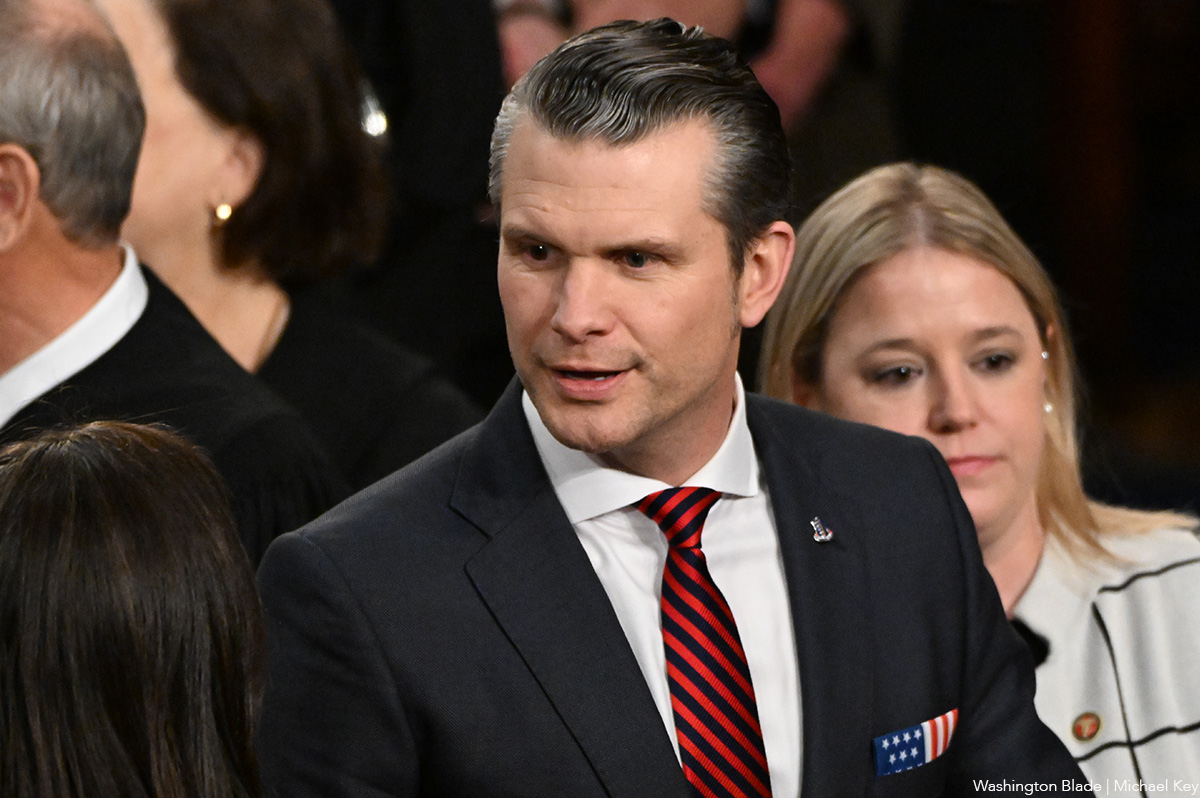
Defense Secretary Pete Hegseth on Monday used an anti-transgender slur while campaigning for U.S. Rep. Zach Nunn (R-Iowa), drawing attention to the Trump-Vance administration’s ongoing efforts to restrict trans people from serving in the military.
“At the Department of War, we do training, not t***nies,” Hegseth said, according to the Iowa Capital Dispatch, which first reported the remarks.
Hegseth made the comment at JR’s SouthPork Ranch at the Iowa State Fair, where he joined Nunn for a rally. The remark came as Hegseth discussed his priorities for the military and argued that the department’s focus should be on military readiness rather than issues of race or gender.
In the same speech, Hegseth claimed that the military operates without regard to race or gender.
“Training, lethality, accountability, discipline, readiness — the bedrock of what it means to be an American warrior — is the only focus of our department,” Hegseth said. “Colorblind, gender-neutral, merit-based. That’s it.”
Hegseth’s remarks come as the Trump-Vance administration continues its efforts to restrict trans people from serving in the military.
Since President Donald Trump returned to the White House, his administration has moved to remove trans service members from the military while also taking steps to prevent trans people from joining.
Trump signed “Prioritizing Military Excellence and Readiness” in January 2025, which attempts to bars trans individuals from serving or enlisting in the U.S. military, citing “military readiness” as the reason, despite there being no factual basis for the ban. The policy has been challenged by LGBTQ+ advocates and military service members, who argue there is no evidence that trans service members undermine military readiness.
Earlier this year, Hegseth made headlines again over the administration’s contradictory approach to hormone therapy, as the military moved to restrict gender-affirming hormone treatment for trans service members while encouraging cisgender military members to receive hormone therapy for “low T,” or testosterone.
The administration’s policy has faced a series of legal challenges from trans service members and advocacy groups.
In June, a federal appeals court panel ruled the administration could not discharge the trans service members who brought one of the lawsuits challenging the ban while their case continues, providing a moment of relief amid the administration’s ongoing efforts to restrict trans military service. The Trump-Vance administration has asked the U.S. Supreme Court to review that ruling and, in the meantime, keep it from taking effect.
The Los Angeles Blade reached out to the Pentagon for comment on Hegseth’s use of the slur, but it did not push back on his choice of words.
“We have nothing further to add beyond the secretary’s remarks,” the statement read.
White House
White House targets gender-affirming care funding, states fight back
Attorneys general from Calif., and elsewhere are fighting directives

The Centers for Medicare and Medicaid Services announced last week that federal funding could no longer be used to pay for gender-affirming care through Medicaid or the Children’s Health Insurance Program.
The rule prohibits federal Medicaid dollars from covering puberty blockers, hormone therapy, and rare instances of surgery for enrollees under the age of 18 in the Medicaid program and under the age of 19 in CHIP. It does not prohibit coverage of counseling or psychotherapy as part of gender-affirming care.
The decision to restrict what healthcare is covered by federal dollars is part of a longer, more aggressive stance the Trump-Vance administration is taking toward LGBTQ+ healthcare.
Since taking the White House back for his second term, Trump has signed three executive orders that directly target transgender Americans. They include Executive Order 14168, “Defending Women From Gender Ideology Extremism and Restoring Biological Truth to the Federal Government” that requires the federal government to recognize only a person’s sex at birth, not their gender identity; Executive Order 14183, “Prioritizing Military Excellence and Readiness,” which attempts to remove transgender service members from the military and prevent them from enrolling; and an executive order that helped spur this change by restricting gender-affirming care.
The administration’s choice to villainize gender-affirming care, despite it being considered a best medical practice recommended by nearly every major medical group for gender dysphoria or gender incongruence, including the American Medical Association, American Academy of Pediatrics, and American Psychological Association, comes as KFF, a source for health policy research and polling data, estimates about 130,000 young trans people with Medicaid or CHIP coverage could be impacted by the policy.
“Today, we are ending federal taxpayer funding for sex-rejecting procedures on children,” U.S. Department of Health and Human Services Secretary Robert F. Kennedy, Jr., said last week when announcing the change. “These interventions carry serious risks and can cause irreversible harm. The federal government will no longer use Medicaid and CHIP dollars to fund procedures that fail to meet the evidentiary standard our children deserve.”
“Children deserve our protection, not experimental interventions that pose serious risks and convey no proven benefits,” said CMS Administrator Mehmet Oz. “By cutting off federal funds for these sex-rejecting procedures, we’re following the science, saving taxpayer dollars, and, most importantly, protecting children from potentially irreversible harm so they can truly flourish.”
The administration’s push is having a chilling effect on state healthcare legislation — more states now prohibit gender-affirming care than ever before. States with gender-affirming care restrictions jumped from four in 2023 to 27 states today.
The funding change has been met with fierce pushback from LGBTQ+ advocates, health experts, and government officials across the country before the rule goes into effect.
Some of the first actions against this policy began in July 2025.
Twenty-one states have attempted to restrict this effort in some fashion from going through as the White House intends. They include Arizona, California, Colorado, Connecticut, Delaware, Illinois, Maryland, Massachusetts, Maine, Michigan, Minnesota, Nevada, New Mexico, New Jersey, New York, Oregon, Rhode Island, Vermont, Washington, and Wisconsin, as well as Pennsylvania Gov. Josh Shapiro on behalf of his state.
The coalition of attorneys general filed lawsuits challenging nine separate provisions of the final rule, arguing that they would make it harder for consumers to get coverage through the ACA, increase costs for states, and weaken key ACA protections.
The U.S. District Court for the District of Massachusetts on Aug. 15 struck down a key provision of a Trump-Vance administration final rule that would have excluded coverage of certain types of gender-affirming care as essential health benefits under the Affordable Care Act. Essential health benefits are subject to the ACA’s financial protections, including limits on out-of-pocket costs.
“Everyone deserves access to health coverage,” said California Attorney General Rob Bonta. “The Trump administration tried to exclude gender-affirming care from qualifying as an essential health benefit. We fought back, and the court’s ruling means this care can — and in many states must — qualify for the ACA’s financial protections, ensuring transgender people have an equal opportunity to benefit from the ACA.”
“The Trump administration tried to make essential care unaffordable for transgender Marylanders by stripping it out of the ACA’s cost protections,” said Maryland Attorney General Anthony Brown. “We fought to keep that care covered, and we won. My Office will always defend Marylanders’ right to the care they need.”
The final rule at issue — the “Marketplace Integrity and Affordability” rule — was proposed by the Trump-Vance administration in March 2025, purportedly to “curb ACA enrollment fraud” and reduce federal spending on subsidies that help consumers afford ACA coverage. Among other changes, the rule would have removed certain types of gender-affirming care from the ACA’s 10 essential health benefit categories.
“This president would rather target young people than lower costs or expand access to health care. It is reprehensible that our federal government is intent on hurting and isolating the adolescents it is supposed to protect. I will use every tool at my disposal to fight this proposal and protect transgender Americans and their families,” said New York Attorney General Letitia James in December after the policy was announced.
In addition to state government resistance to the change, multiple LGBTQ+ advocates have committed to protecting the right to healthcare for LGBTQ+ children.
Rocky Mountain Equality CEO Mardi Moore affirmed those in Colorado would continue to help people most at risk if the change goes through.
“First, to the families impacted by this news: you will not be cut off immediately. The rule takes effect Oct. 13, 2026, and providers can continue to bill Medicaid and CHIP for youth already receiving gender-affirming care for up to six months after that. Rocky Mountain Equality is here, and we can help you understand your options to continue your child’s care.
“This is discrimination dressed up as rule-making. Government healthcare policy should expand what people can access, not strip away care that families and doctors have already determined is medically necessary,” Moore added. “We’ve seen this pattern before with other kinds of essential care, and it rarely stops with just one restriction. Any effort to ban or limit care opens the door for more restrictions on more kinds of care.”
The Human Rights Campaign, the largest LGBTQ+ lobbying group in the U.S., issued multiple statements following the announcement, and has filed a similar lawsuit against the federal government for prohibiting gender-affirming care to federal employees using federal health plans.
HRC President Kelley Robinson said taking a hard stance against what the administration is presenting as a win for the American people that will ultimately restrict healthcare options for thousands of Americans.
“Every young person is entitled to the health care that they, their parents, and their medical providers agree that they need, without politicians interfering with these important and highly personal decisions. And yet, rather than working to make healthcare more affordable and accessible, the Trump administration continues to obsess over the healthcare needs of trans youth, this time by cutting off health insurance coverage for those who rely on Medicaid and CHIP to access that care,” Robinson said. “The Trump administration is terrorizing trans youth and their families with these kinds of actions, and it has to stop.”

Defying convention (and physics): ‘Speedball’ Mike Bailey on identity and inclusion in pro-wrestling

Gloria Steinem dies at 92

How gay nerds will shape the midterm elections

Markey’s primary win deemed success for LGBTQ+ activists

Medical information queer men should know

Poland begins to legally recognize same-sex marriages from other countries

HRC president campaigns for Chris Pappas in NH

We watched them, then we lost them: Why the passing of rising pornstar Christian Styles, iconic country singer Dolly Parton, and legendary performer Tim Curry hit home hard

From the desk of Equality California: End of August top political news for California’s LGBTQ

Shooting outside gay bar in Ariz. leaves three dead
-
 Poland4 days ago
Poland begins to legally recognize same-sex marriages from other countries
-
 Congress3 days ago
HRC president campaigns for Chris Pappas in NH
-
 Commentary5 days ago
We watched them, then we lost them: Why the passing of rising pornstar Christian Styles, iconic country singer Dolly Parton, and legendary performer Tim Curry hit home hard
-
 Politics4 days ago
From the desk of Equality California: End of August top political news for California’s LGBTQ
-
Arizona3 days ago
Shooting outside gay bar in Ariz. leaves three dead
-

 Gossip5 days ago
Spilling some dating tea with the guys from ‘A Little Throuple Tea’
-
 Fitness4 days ago
Fitness for beginners: The start of a new journey
-

 Bulgaria2 days ago
Top Bulgarian court rules government must legally recognize trans people
-
 Celebrity News11 hours ago
Gloria Steinem dies at 92
-

 Fitness2 days ago
Naked Warrior Yoga is fighting to stay in the heart of West Hollywood